

Power of Attorney
Using a power of attorney enables you to give someone permission to act on your behalf and manage medical, financial, real estate, business, or personal affairs.
Select a state




What is a power of attorney?
A power of attorney, also called a POA, is a document where one person, a “principal,” appoints another person, an “agent,” to act on their behalf with respect to certain matters, such as medical, finance, real estate, and business transactions.
A power of attorney may be limited to specific acts or types of acts, or may cover a wide variety of personal and business decisions. They may also be temporary, lasting for only a specified timeframe, or durable, which remains effective even after the principal becomes incapacitated.
A power of attorney is an important tool for estate planning and can help avoid the need for court-appointed guardianship if the principal becomes unable to manage their affairs. However, it is crucial to choose a trustworthy agent, as the POA is granted through a formal document signed by the principal and grants significant authority over the principal’s affairs.
Choose the right power of attorney for you
Durable Power of Attorney This power of attorney will stay in effect even if the principal becomes incapacitated. These typically grant plenary decision-making for the agent over the principal's affairs, but may be limited depending on the language or purpose set forth in the document.
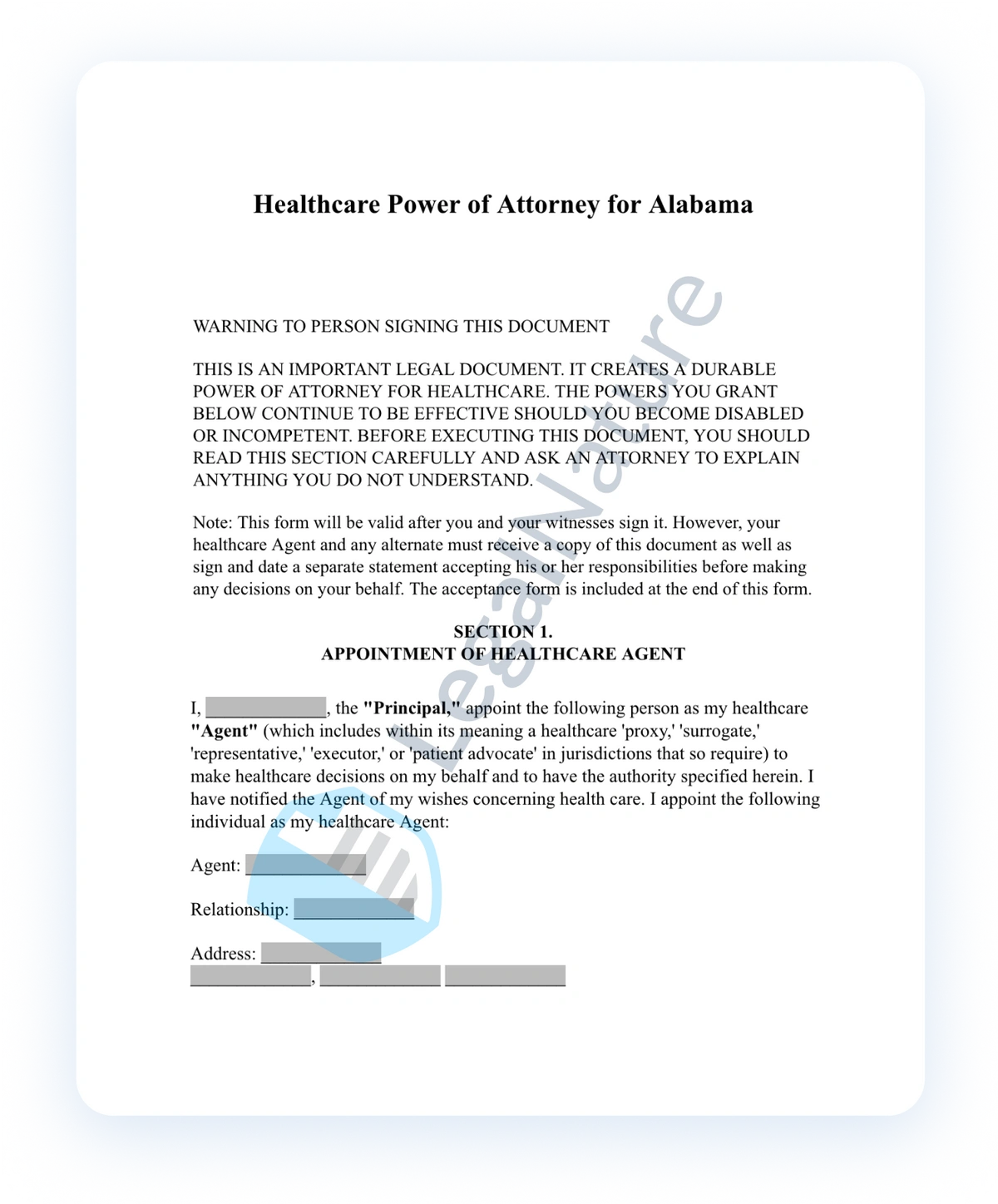
Healthcare Power of Attorney This power of attorney is used to designate an agent or healthcare proxy to make medical decisions on the principal's behalf if the principal becomes incapacitated or unable to communicate their wishes.
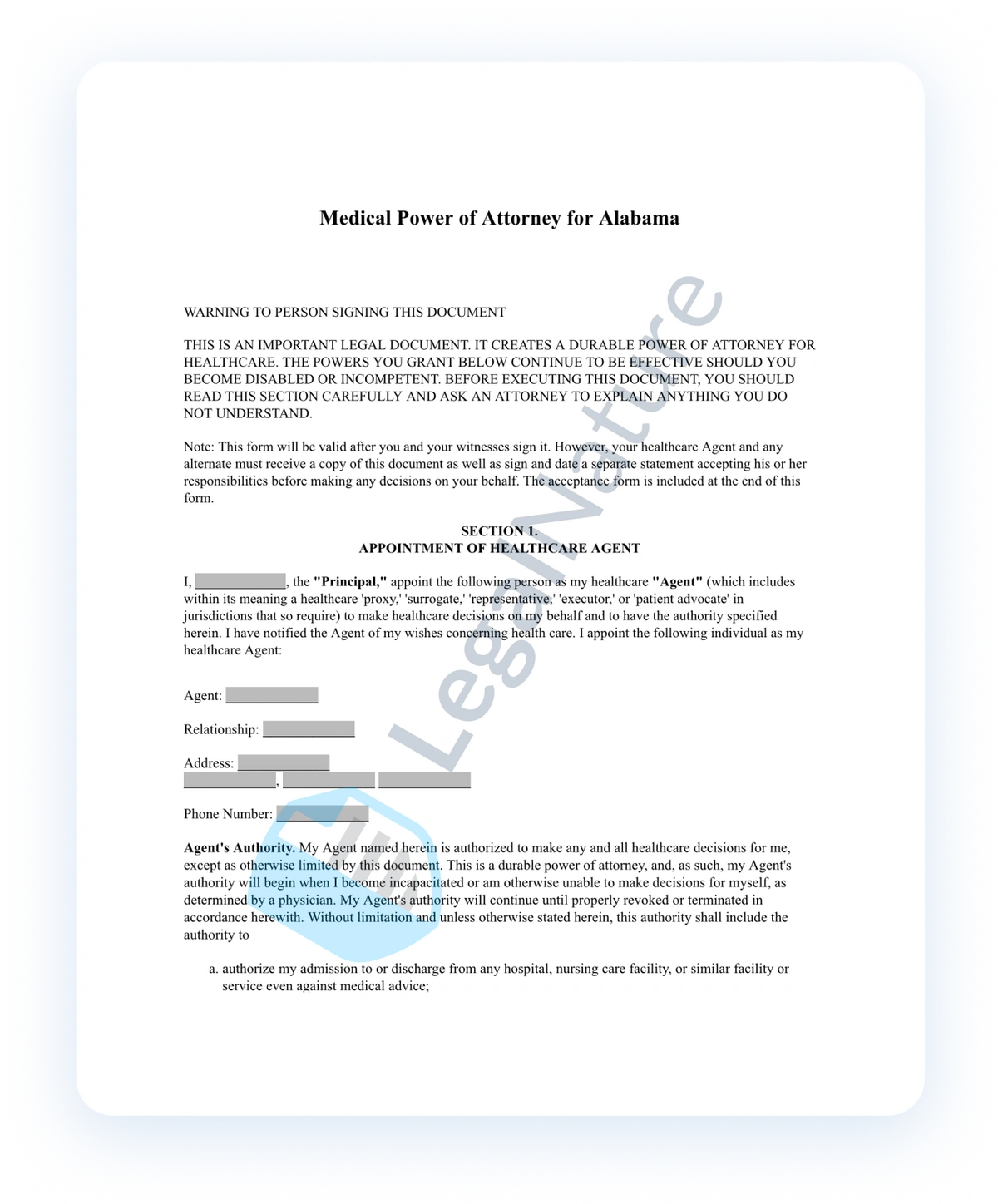
Medical Power of Attorney Another name for a healthcare power of attorney, this document is used to designate an agent or healthcare proxy to make medical decisions on the principal's behalf if the principal becomes incapacitated or unable to communicate their wishes.
Power of attorney requirements vary by state. Select your state below to create a legally compliant document.
When to use a power of attorney
A power of attorney is a useful tool for when:
- you want to give someone permission to act on your behalf; and
- you wish to appoint an agent to manage your financial, business, real estate, or other personal affairs.
Who may act as your agent?
In general, only certain persons who meet legal requirements—such as being at least 18 years old and of sound mind—are eligible to serve as an agent. Many principals choose to appoint their adult children as agents, considering factors like trustworthiness, capability, and family dynamics when making this decision.
Create your power of attorney in 4 easy steps
Name Your Agent
Your appointed representative, often called an agent, must be 18+ and is legally bound to follow your instructions and act on your wishes. Choose someone trustworthy, typically a close friend or family member.
Communicate Your Wishes
Fill out our form and determine whether your power attorney will be limited in either scope or duration, or general and durable. You may also determine exactly which decision-making powers you wish to grant your agent in addition to any special instructions.
Review and Sign Your Document
A power of attorney document must be signed and notarized in order to be valid. Several states require witnesses to the signatures as well.
Distribute Copies
Once your power of attorney is complete, copies should be made and distributed to all parties, including the principal, agent, and any third parties that may involve the principal's affairs as they pertain to the scope of the power of attorney.
Why create a power of attorney?
Creating a power of attorney is a crucial step in estate planning and personal management for several important reasons:
-
Avoiding guardianship: By designating an agent through a POA, you can prevent the need for a court-appointed guardian or conservator, which can be costly and time-consuming.
-
Financial management: A POA allows your chosen agent to handle your financial affairs, including paying bills, managing investments, and protecting assets.
-
Healthcare decisions: A healthcare POA specifically authorizes someone to make medical decisions for you if you are unable to communicate your wishes.
-
Clarity of intent: A well-drafted POA clearly communicates your wishes, reducing potential conflicts among family members about your care or financial management.
-
Asset protection: A comprehensive POA can enable your agent to engage in asset protection strategies if needed, potentially saving significant amounts of money.
-
Flexibility: You can customize a POA to be as broad or specific as you want, tailoring it to your unique needs and circumstances.
-
Peace of mind: Having a POA in place provides comfort, knowing that your affairs will be managed according to your wishes even if you are unable to do so yourself.
-
Convenience: A POA can be useful for handling financial or legal matters when you are unavailable due to travel or other commitments.
-
Protection for the agent: A properly drafted POA can protect your chosen agent from allegations of financial abuse by clearly outlining their authority.

Why choose LegalNature?
The professionals at LegalNature offer the expertise and guidance to navigate the nuances of power of attorney creation across all 50 states and the District of Columbia. LegalNature offers a 30-day money-back guarantee. If you're not happy, then we’re not happy. Give us a call and let us help.
Power of Attorney Guide
No matter what type of power of attorney you need, LegalNature’s intuitive power of attorney form makes it easy to give your agent authority over almost all of your affairs, and our power of attorney form gives you complete flexibility in tailoring the instrument to your specific needs.
It is important to use standardized attorney forms for legal and financial transactions to ensure validity and acceptance by institutions. LegalNature provides attorney forms that meet these requirements.
Below, you will find a detailed description of the main sections and key components of LegalNature’s customizable power of attorney template in the order that they appear in the paperwork. This information describes how powers of attorney work generally. Note that some of these sections may be omitted from your agreement depending on how you answer the relevant questions.
Types of Power of Attorney
To begin, you need to determine whether you wish to complete a medical, durable, or general power of attorney. Under any power of attorney, the person creating and signing the authorization—the “principal”—appoints another person—the “agent” (a.k.a. the attorney-in-fact)—to manage specific matters on the principal’s behalf.
-
A medical power of attorney is used to appoint an agent to manage healthcare matters when the principal becomes incapacitated and unable to communicate.
-
A durable power of attorney is the same except the agent only has authority over non-medical matters, such as financial, business, and real estate affairs. There are durable powers that remain effective even if the principal becomes incapacitated, making them practical for ongoing needs.
-
A general power of attorney is also used for non-medical matters; however, the agent may only act on the principal’s behalf while the principal remains in good health and is able to communicate. This is sometimes referred to as an ordinary power of attorney, which is only valid while the principal has mental capacity and terminates upon incapacity or death.
Some powers of attorney grant broad powers, allowing the agent to manage a wide range of affairs for the principal. While this can provide convenience and protection, it is important to carefully consider and oversee the extent of authority granted.
If you wish to restrict the agent’s authority, you can create a limited power of attorney, which grants the agent authority only for specific tasks or within a defined timeframe.
A document called a springing power of attorney only becomes effective upon a specified event, such as the principal’s incapacitation. The importance of clearly defining the triggering event within the document called a springing power of attorney cannot be overstated, as it ensures proper activation and avoids confusion. Springing powers are often used in healthcare and financial contexts, and typically require a physician’s declaration to take effect.
Naming Your Agent
The person you appoint to handle your affairs might be called an “agent,” “proxy,” “representative,” or something else depending on the state you live in. By signing this record, your agent is legally obligated to follow your written instructions and to always try to act according to your known wishes. Note that our living will form includes a healthcare power of attorney within it and also allows you to specify your preferences in the event that you can no longer speak for yourself.
The agent you appoint is required to be 18 years of age or older. It is important to read your completed form thoroughly to ensure that you have met all requirements mandated by your state. For instance, some states prohibit you from naming your doctor or an employee of your healthcare provider as your representative. Most people opt to appoint a trusted friend or family member. Other family members generally do not have the authority to override the agent's decisions unless they seek court intervention. You may also appoint more than one agent or an other agent to act as a backup or to share responsibilities.
Successor Agents
You will need to name backup agents, called “successor agents,” in case your first choice is unable or unwilling to represent you when the time comes. For instance, your first choice may become ill, pass away, or simply no longer wish to act on your behalf.
In any case, appointing multiple successor agents is a smart way to ensure that someone you trust eventually becomes your agent. In your power of attorney, each agent and successor agent will be specifically identified by their names, addresses, and phone numbers to prevent any possible confusion over their identities.
Other Appointments
It is also recommended that you appoint a personal guardian. This person will be responsible for managing your personal affairs if you become incapacitated. Again, appointing someone that you know and trust is crucial for preventing a court-appointed guardian being assigned to you, since such guardians will not necessarily have your best interests in mind.
Period of Effectiveness
Here you will indicate when the power of attorney will go into effect and the length of the agent’s authority.
For instance, you can choose to empower the agent to have authority take effect immediately or at a later date. You may specify that the power of attorney becomes effective immediately upon signing, or only upon a certain condition, such as incapacity. When completing a durable power of attorney, you can authorize this to occur when you become incapacitated. Here, “incapacitated” means whenever the principal is unable to comprehend and analyze his or her personal affairs in order to make competent decisions. This could result from either physical or mental impairment. Unlike a durable power of attorney, in a general power of attorney the agent’s authority normally does not continue after incapacitation. Financial institutions or other parties may require the original document to verify the agent’s authority, so it should be kept safe but not handed over permanently.
You will also choose when the agent’s authority ends. This could be a specified end date, or you might choose to allow the agent to continue serving indefinitely until the principal decides to revoke the authority. In a durable power of attorney, the agent will normally continue serving even after the principal’s incapacitation. However, a power of attorney generally terminates when the principal dies.
Indicating a specific end date is often appropriate when the principal will be traveling or otherwise unable to attend to their own personal affairs for a certain amount of time. For instance, military personnel often sign over powers of attorney to a spouse or trusted friend while deployed on duty. Note that if you are unsure as to the exact time frame needed, you can always extend or revoke the authority at any time down the road. This means that your best guess should suffice.
Agent as Fiduciary
Under a power of attorney, the principal and agent are in a “fiduciary relationship.” This means that the agent is always required to act in the principal’s best interest and that their relationship is one of the highest trust and confidence. The agent is authorized to act on the principal's behalf in the matters specified in the power of attorney. An agent who acts outside of the fiduciary relationship may end up seeing their authority revoked and possibly other legal consequences. This protection allows principals to rest easy knowing that the law will protect them if the agent abuses their authority.
General Authority to Act
The principal may choose to provide blanket authority to the agent, allowing them to handle any matter on their behalf. In this case, your form will still provide an itemized list of powers. Banks, hospitals, and other organizations will sometimes only accept a power of attorney if it specifically states the power the agent is trying to exercise. If the principal does not provide total authority, you will then select from the following specific powers you wish to authorize:
-
“Real property” authorizes the agent to purchase, sell, and otherwise handle the principal’s real estate matters. The agent may also be authorized to sell property on the principal's behalf as permitted by state law. Real estate includes any property interest, such as homes, condos, undeveloped plots, and partial interests.
-
“Tangible personal property” authorizes the agent to purchase, sell, and handle the principal’s items of physical personal property. Examples include jewelry, vehicles, furniture, art, and heirlooms.
-
“Stocks and bonds” allow the agent to buy, sell, and manage stocks and bonds on the principal’s behalf.
-
“Commodities and options” grant the agent the authority to buy, sell, and manage commodities and options on the principal’s behalf.
-
“Banks and financial institutions” authorize the agent to deal with financial institutions on the principal’s behalf. This may include opening and closing bank accounts; depositing and withdrawing funds; receiving and monitoring account statements; taking out loans to support other financial, business, or legal interests; and managing debit and credit cards. The agent may also need to review financial statements to manage the principal's accounts and transactions effectively.
-
“Operation of entity or business” grants the agent the authority to buy, sell, manage, or terminate the principal’s interest in businesses they own. Examples include hiring decisions, contractual dealings, legal strategy, investment strategy, public relations, and financial decisions.
-
“Insurance and annuities” allow the agent to manage any of the principal’s insurance plans or annuities, including changing or ending them.
-
“Estates, trusts, and other beneficial interests” enables the agent to handle the principal’s estate planning, trusts, and other beneficial interests. A “beneficial interest” is the right to profit, distribution, property, title, or other benefits on assets held within an estate, trust, or agreement (i.e. funds from trusts, wills, guardianships, escrow accounts, etc.).
-
“Claims and litigation” allows the agent to act for the principal regarding legal disputes, including settling actions, submitting claims to dispute resolution, and paying or receiving a judgment.
-
“Personal and family maintenance” allows the agent to ensure that the principal’s family maintains its standard of living by providing funds for living expenses, health care, and education.
-
“Benefits from governmental programs and civil or military service” allows the agent to manage government benefits, such as government loans, tax savings, and pension plans.
-
“Retirement plans” allows the agent to create, maintain, and alter the principal’s interest in and benefits under any retirement plans, accounts, or portfolios.
-
“Taxes” allows the agent to manage the principal’s taxes at the federal, state, or local level.
-
“Gifts” allows the agent to give gifts to the principal’s desired beneficiaries out of the principal’s assets. For example, this could include trusts or savings accounts for the principal’s children.
Specific Acts Authorized
Here you will find less common powers you may want to authorize. The following definitions will aid your understanding of these powers:
-
“Right of survivorship” is a joint property right that allows a joint owner to receive the interest of another joint owner that passes away.
-
“Beneficiaries” are any person or entity entitled to receive assets, profits, gifts, or another benefit. Beneficiaries usually receive such benefits from the principal, the principal’s estate, a trust, or an insurance policy.
-
“Delegation” authorizes the agent to pass on all or part of their authorized powers to a third party.
-
“Waiving the principal’s rights” means that the agent may formally give up a right that the principal has to a retirement plan, annuity, or other benefit. This sometimes happens, for instance, when the principal would have wanted a spouse or other beneficiary to receive the benefit under the circumstances.
-
“Exercise fiduciary powers” allows the agent to perform any fiduciary duties that the principal may have. This might include acting as a trustee or a board member. Local state law may stipulate what fiduciary powers the agent can or cannot perform.
-
“Disclaim property interests” grants the agent the power to give up the principal’s property interest.
-
“Inter vivos trust” means a trust created during the principal’s life with the assets (usually) to be disbursed upon the principal’s death.
-
“Pets” are often addressed in a durable power of attorney. Agents may have the authority to provide support for the principal’s pets, including making boarding arrangements, paying veterinary bills, and maintaining the pets’ standard of living.
-
“Funeral and burial arrangements” allow the agent under a durable power of attorney the authority to make funeral, memorial, burial, or cremation arrangements after the principal passes away. This may include buying a cemetery plot, ordering cremation, and following instructions from the advance healthcare directive and the healthcare agent or proxy, if one exists.
-
“Gifts to agent” allows the agent to make limited monetary or property gifts from the principal’s assets to themselves. This gift must not exceed the annual federal gift tax exclusion amount provided by the Internal Revenue Service (IRS). Allowing this power can help ensure that the agent can maintain their standard of living, health care, and education. It does not grant the agent complete power to use the principal’s assets for whatever they want. It does allow the agent to give gifts to themselves under limited circumstances and only in accordance with the principal’s expressed wishes.
-
“Nominating a conservator” allows the agent under a durable power of attorney to designate a conservator for the principal if the principal does not name one themselves and protective proceedings are initiated by the court when the principal becomes incapacitated. The agent may nominate themselves to be the principal’s conservator. This power is normally recommended in order to guard against the possibility of a court-appointed conservator being assigned, who will not necessarily have the principal’s best interests in mind.
-
“Taxes” authorizes the agent to handle tax matters for the principal. This may include the authority to file tax returns on behalf of the principal, pay taxes owed, and communicate with tax authorities.
-
“Other matters, alter ego, incidental powers” allows the agent all rights to act on the principal’s behalf as if they are the principal’s alter ego. This includes all matters that are not stated within the power of attorney, so long as it does not contravene the principal’s wishes.
Special Instructions
You also have the option of including any special wishes, terms, restrictions, or instructions. It is a good idea to include any general goals here, even if they have already been communicated to the agent orally.
Amplifying Powers
This section of the form specifies the agent’s rights to compensation for their effort. For instance, the agent may be paid monthly for their services. However, the agent will be required to itemize their costs and expenses, which must be reasonable.
Here, the principal also affirms that banks and other third parties may rely on the representations made by the agent without fear of reprisal.
Finally, this section states that the agent cannot be held responsible for any unintentional or negligent wrongdoing so long as they seek to act in the principal’s best interests or according to their wishes. This is essential for encouraging agents to accept their appointments.
Financial Management
Financial management is one of the most significant responsibilities that can be assigned through a power of attorney. By granting financial powers to an agent, the principal authorizes them to manage a wide range of financial affairs, including accessing and managing bank accounts, paying bills, making investments, and handling other monetary transactions. The agent must always act in the best interest of the principal, ensuring that all actions taken align with the principal’s financial goals and preferences.
The powers granted can be as broad or as limited as the principal desires. For example, the principal may choose to allow the agent to manage only certain bank accounts or restrict their authority to specific transactions, such as paying bills or handling investments. In situations where the principal’s financial affairs are complex, it may be beneficial to appoint more than one agent. These agents can be required to act jointly, providing an additional layer of oversight and ensuring that decisions are made collaboratively.
Selecting an agent with experience in financial management is crucial, as they will be responsible for making important decisions that can impact the principal’s financial well-being. The attorney-in-fact should be someone trustworthy, capable, and willing to act with integrity and diligence. By clearly outlining the scope of financial powers in the attorney form, the principal can ensure that their financial matters are managed according to their wishes.
Health Care Decisions
A power of attorney for health care decisions empowers an agent to act on the principal’s behalf if they become mentally incapacitated and are unable to make or communicate their own medical choices. This legal document allows the agent to make crucial decisions related to medical care, including consenting to or refusing treatment, making choices about life support, and ensuring that the principal’s medical wishes are respected.
The powers granted to the agent can be tailored to the principal’s preferences, allowing them to specify which health care decisions the agent is authorized to make. For example, the principal may limit the agent’s authority to certain types of medical decisions or treatments, or provide detailed instructions regarding end-of-life care and life support measures. It is essential to choose an agent who understands the principal’s values and medical wishes, as they will be responsible for making decisions that reflect the principal’s best interests.
By appointing a trusted person as a health care agent, the principal ensures that their medical care will be managed according to their wishes, even if they are no longer able to express them. This advanced planning provides peace of mind for both the principal and their family members, knowing that important health care decisions will be made by someone who is familiar with their preferences and authorized to act on their behalf.
Estate Planning
A power of attorney is a valuable tool in estate planning, as it allows the agent to manage the principal’s assets and make decisions regarding the distribution of property. The agent may be granted authority to handle real estate transactions, such as selling property or managing rental agreements, as well as overseeing investments and insurance policies. These powers can be customized to fit the principal’s specific estate planning needs, ensuring that only the desired assets or transactions are included.
By granting estate planning powers to a trusted agent, the principal can ensure that their property and other assets are managed efficiently and in accordance with their wishes. The agent’s authority can extend to handling insurance policies, managing investment portfolios, and making decisions about other property as outlined in the attorney document. This can be especially important if the principal becomes unable to manage their own affairs due to illness or incapacity.
Choosing an agent with experience in estate planning and a clear understanding of the principal’s goals is essential. The powers granted should be clearly defined in the attorney form to avoid confusion and ensure that the agent acts within the scope of their legal authority. With proper planning, a power of attorney can help streamline the management of the principal’s estate and provide continuity in the handling of their financial and property matters.
Limitations and Revocation
A power of attorney is a flexible legal instrument that can be tailored to the principal’s needs and revoked at any time, provided the principal remains mentally competent. The principal has the right to set specific limitations on the agent’s authority, restricting their powers to certain transactions, decisions, or timeframes. These limitations should be clearly stated in the attorney form to ensure that the agent understands the extent of their authority.
If the principal wishes to revoke the power of attorney, they can do so by providing written notice to the agent and any relevant third parties, such as financial institutions or health care providers. It is also advisable to create a new power of attorney document or a written statement of revocation to formally terminate the agent’s authority. Regularly reviewing and updating the power of attorney ensures that it continues to reflect the principal’s current wishes and circumstances.
By maintaining control over the scope and duration of the agent’s authority, the principal can ensure that their interests are protected and that the power of attorney remains an effective tool for managing their affairs.
State-Specific Laws
Power of attorney laws can vary significantly from state to state, making it essential to understand the specific legal requirements in your jurisdiction. Some states require that the attorney form be notarized or witnessed, while others have unique rules regarding the content, format, or execution of the document. Additionally, certain states may have specific regulations for powers of attorney used in financial institutions, health care settings, or government offices.
To ensure that your power of attorney is valid and enforceable, it is important to consult with a lawyer or legal expert familiar with your state’s laws. This will help you comply with all legally required procedures and avoid potential challenges to the document’s validity. Understanding state-specific laws also ensures that the powers granted to your agent will be recognized by banks, health care providers, and other institutions when acting on your behalf.
By taking the time to understand and follow your state’s requirements, you can create a power of attorney that provides effective legal authorization for your agent to act in your best interest.
Principal’s Signature
After the principal finishes reviewing the power of attorney, they may need to sign in the presence of witnesses according to their state’s rules as indicated in the form.
Notice to Person Accepting Appointment
This notice is attached to the form and acknowledges that the agent understands their duties and responsibilities. The agent should carefully read the power of attorney and this notice prior to signing and accepting the nomination as agent. The agent is advised to find legal counsel or consult with lawyers if they have any questions or concerns.
Notary Acknowledgment
Although not always required in every state, it is recommended that you use a notary public to witness the signing, as a notary public can confirm the authenticity of the signatures and help ensure the validity of the authorization should it ever be disputed in court.
Statement of Witness
Here, the witnesses sign a statement affirming the principal's identity, that they signed the power of attorney in the witness’ presence, that they are of sound mind and memory, that the signature was not procured fraudulently, and that the witness or witnesses are not serving as agents (i.e. meaning that they are disinterested parties without any conflicts of interest).
Executing Your Document
Since banks and other institutions often require powers of attorney to be notarized, we recommend that you use a notary even if your state does not require it. In some cases, you may also need to file or record your power of attorney with a government office to ensure its legal recognition. Additionally, a healthcare power of attorney is a separate document from other advance directives, such as a living will or financial power of attorney, and serves a distinct legal purpose.
Create your power of attorney in minutes
Complete our form
;fill-opacity:1;'/%3e%3cpath%20fill-rule='evenodd'%20clip-rule='evenodd'%20d='M7.17816%205.46484C8.48591%205.46484%209.81742%206.23165%2011.1727%207.76529C10.8517%208.08628%2010.6467%208.28838%2010.5575%208.3716C10.4683%208.45482%2010.2514%208.6391%209.90659%208.92442C9.56182%209.20975%209.28244%209.40591%209.06844%209.51291C8.85445%209.6199%208.5721%209.73285%208.22138%209.85173C7.87067%209.97062%207.52293%2010.0301%207.17816%2010.0301C6.75017%2010.0301%206.35785%209.97656%206.00119%209.86957C5.64453%209.76257%205.28788%209.5783%204.93122%209.31675C4.57456%209.0552%204.29518%208.83229%204.09307%208.64801C3.89096%208.46374%203.58781%208.16355%203.18359%207.74745C3.95636%206.97469%204.64291%206.40107%205.24329%206.02658C5.84367%205.65209%206.48862%205.46484%207.17816%205.46484ZM7.17816%209.37024C7.61804%209.37024%207.9955%209.20975%208.31055%208.88876C8.6256%208.56776%208.78312%208.18733%208.78312%207.74745C8.78312%207.30757%208.6256%206.92714%208.31055%206.60615C7.9955%206.28516%207.61804%206.12466%207.17816%206.12466C6.73828%206.12466%206.36082%206.28516%206.04577%206.60615C5.73072%206.92714%205.5732%207.30757%205.5732%207.74745C5.5732%208.18733%205.73072%208.56776%206.04577%208.88876C6.36082%209.20975%206.73828%209.37024%207.17816%209.37024ZM7.17816%207.1768C7.17816%207.34324%207.23166%207.47996%207.33865%207.58696C7.44565%207.69395%207.58237%207.74745%207.74881%207.74745C7.8677%207.74745%207.98658%207.70584%208.10547%207.62262V7.74745C8.10547%208.009%208.01631%208.23191%207.83798%208.41619C7.65965%208.60046%207.43971%208.6926%207.17816%208.6926C6.91661%208.6926%206.69667%208.60046%206.51834%208.41619C6.34001%208.23191%206.25085%208.009%206.25085%207.74745C6.25085%207.4859%206.34001%207.26299%206.51834%207.07872C6.69667%206.89444%206.91661%206.80231%207.17816%206.80231H7.32082C7.22571%206.9212%207.17816%207.04603%207.17816%207.1768Z'%20fill='white'%20style='fill:white;fill-opacity:1;'/%3e%3c/svg%3e)
Preview and download your document
;fill-opacity:1;'/%3e%3cg%20clip-path='url(%23clip0_10486_8655)'%3e%3cpath%20d='M10.8931%205.49519C10.8004%205.45343%2010.6879%205.48908%2010.6427%205.57565L10.4595%205.92398L10.3128%205.85879L10.5058%205.49212L10.5069%205.48906C10.508%205.48703%2010.5091%205.48397%2010.5103%205.48194C10.54%205.4137%2010.5743%205.33324%2010.5864%205.24258C10.6239%204.97267%2010.5125%204.68749%2010.2874%204.47869C10.0733%204.28007%209.74562%204.16804%209.43445%204.18534C9.36934%204.18942%209.29984%204.20062%209.22812%204.21998C9.11446%204.25053%209.00302%204.30349%208.8982%204.37785C8.82316%204.4308%208.71833%204.52146%208.64661%204.64877L8.64551%204.65184L8.64441%204.65387L7.9603%205.95657C7.95698%205.96166%207.95369%205.96675%207.95037%205.97286C7.94705%205.97795%207.94485%205.98406%207.94265%205.99017L6.17057%209.36151C6.14408%209.41244%206.13085%209.46947%206.13305%209.5265V9.52752L6.17277%2010.6143C6.17718%2010.7202%206.22022%2010.819%206.29194%2010.8964L6.18712%2011.0919C6.14078%2011.1775%206.1794%2011.2814%206.27207%2011.3242C6.29856%2011.3364%206.32724%2011.3425%206.35483%2011.3425C6.42435%2011.3425%206.49056%2011.3069%206.52366%2011.2458L6.62516%2011.0553C6.64061%2011.0563%206.65495%2011.0573%206.6704%2011.0573C6.77412%2011.0573%206.87673%2011.0278%206.9628%2010.9687L7.91392%2010.325C7.93379%2010.3118%207.95254%2010.2955%207.96909%2010.2792C7.97241%2010.2761%207.97461%2010.2731%207.97793%2010.27C7.9989%2010.2476%208.01655%2010.2222%208.0309%2010.1957L10.1483%206.16942L10.2951%206.23461L9.35169%208.02823C9.30645%208.11379%209.34507%208.21768%209.43886%208.25943C9.46535%208.27165%209.49293%208.27674%209.52052%208.27674C9.59004%208.27674%209.65735%208.24109%209.68935%208.17896L10.7023%206.25293C10.7078%206.24581%2010.7133%206.23766%2010.7177%206.2295C10.7222%206.22134%2010.7244%206.21422%2010.7277%206.20606L10.9804%205.72533C11.0255%205.64082%2010.9858%205.53694%2010.8931%205.49519ZM6.73994%2010.6907C6.70574%2010.7131%206.6627%2010.7182%206.62408%2010.7049C6.61857%2010.7019%206.61305%2010.6988%206.60643%2010.6958C6.60312%2010.6948%206.60092%2010.6937%206.5976%2010.6927C6.5656%2010.6723%206.54575%2010.6398%206.54463%2010.6041L6.51814%209.89623C6.76641%2010.0745%207.05219%2010.2028%207.35673%2010.2741L6.73994%2010.6907Z'%20fill='white'%20style='fill:white;fill-opacity:1;'/%3e%3cpath%20d='M5.59896%2011.03C5.55151%2011.029%205.49634%2011.03%205.43897%2011.03C5.13885%2011.0331%204.57941%2011.0382%204.40067%2010.8538C4.36976%2010.8222%204.33005%2010.7652%204.3444%2010.647C4.38634%2010.314%204.58935%209.96362%204.76811%209.65499L4.79789%209.60305C4.85638%209.50221%204.91707%209.40036%204.97664%209.30056C5.14766%209.01537%205.32421%208.72%205.46433%208.40935C5.56806%208.18018%205.62542%207.96426%205.63536%207.7697C5.64859%207.50897%205.57799%207.28183%205.42571%207.09441C5.24365%206.86932%204.97774%206.70431%204.61361%206.58821C4.31128%206.49145%203.97806%206.44154%203.68455%206.39672C3.55215%206.37635%203.42635%206.35801%203.3105%206.33561C3.20899%206.31626%203.10969%206.37737%203.08982%206.47108C3.06885%206.56478%203.13505%206.65645%203.23658%206.67479C3.36015%206.69822%203.48926%206.71756%203.62497%206.73793C4.18219%206.82248%204.81444%206.91719%205.1256%207.30118C5.30986%207.52832%205.30766%207.85628%205.11788%208.2759C4.98547%208.56925%204.81444%208.85545%204.64783%209.13248C4.58825%209.23231%204.52646%209.33619%204.46687%209.43905L4.43709%209.48998C4.2418%209.82609%204.02111%2010.207%203.97146%2010.6053C3.9472%2010.7957%203.99795%2010.9567%204.12152%2011.084C4.38082%2011.3498%204.8939%2011.3763%205.29223%2011.3763C5.34408%2011.3763%205.39485%2011.3763%205.44229%2011.3753C5.49855%2011.3753%205.55043%2011.3743%205.59456%2011.3753C5.59566%2011.3753%205.59566%2011.3753%205.59676%2011.3753C5.69939%2011.3753%205.78324%2011.2989%205.78434%2011.2041C5.78544%2011.1105%205.70266%2011.031%205.59896%2011.03Z'%20fill='white'%20style='fill:white;fill-opacity:1;'/%3e%3c/g%3e%3cdefs%3e%3cclipPath%20id='clip0_10486_8655'%3e%3crect%20width='7.91304'%20height='7.30435'%20fill='white'%20style='fill:white;fill-opacity:1;'%20transform='translate(3.08594%204.12891)'/%3e%3c/clipPath%3e%3c/defs%3e%3c/svg%3e)
Review and sign your document