


Medical Power of Attorney
A medical power of attorney enables you to appoint a trusted person with the legal authority to make medical decisions on your behalf when you are unable to do so.
Select a state


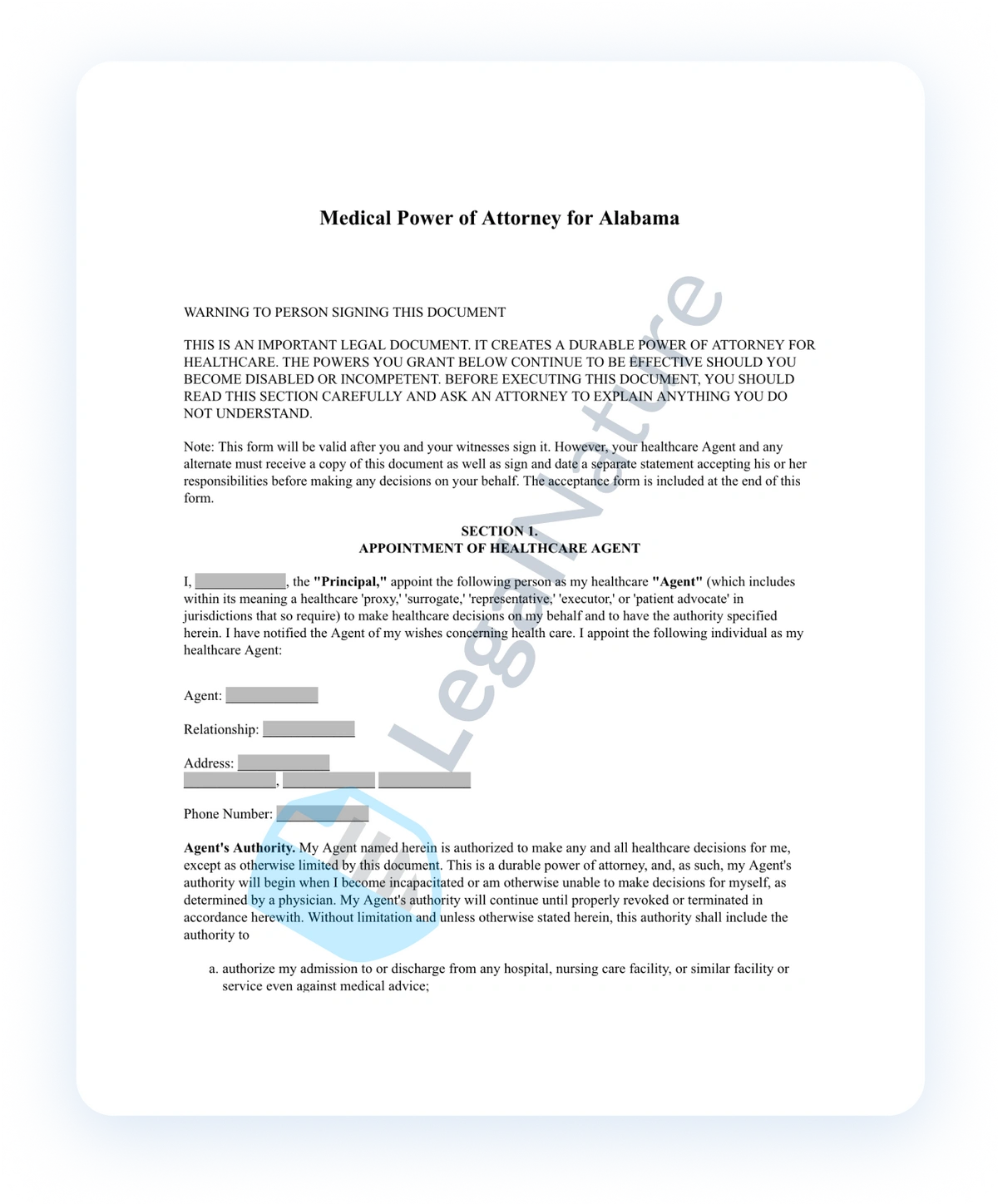
What is a medical power of attorney?
A medical power of attorney (MPOA) is a legal document that allows an individual to designate another person to make medical decisions on their behalf if they become incapacitated, permanently unconscious, or unable to communicate their wishes. This designated person, known as the agent or healthcare proxy, has the authority to make crucial healthcare decisions, including consenting to or refusing medical procedures. Unlike a durable power of attorney, the agent's powers are limited to medical, healthcare, and end-of-life decisions.
Choose the right power of attorney for you
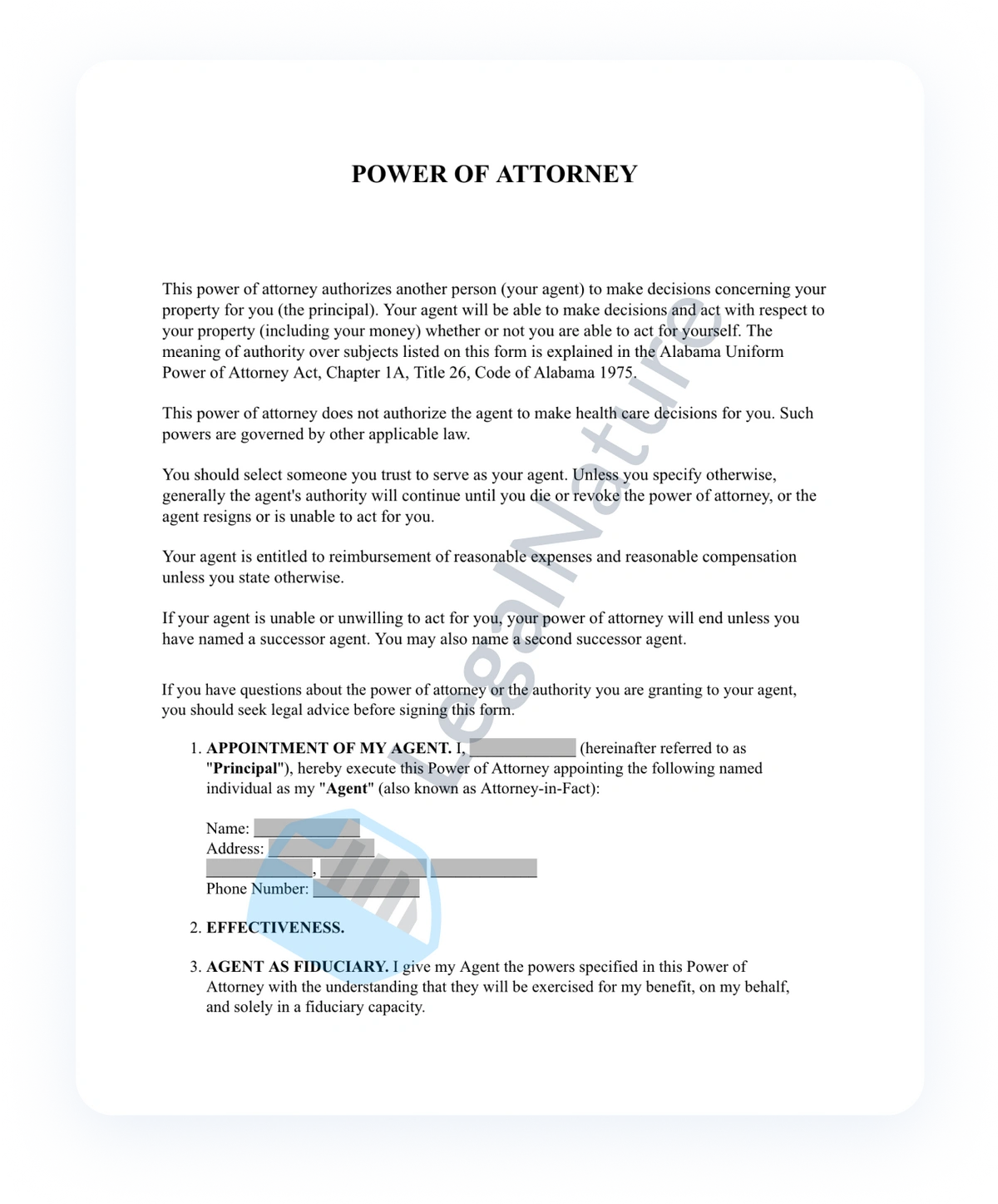
Durable Power of Attorney This power of attorney will stay in effect even if the principal becomes incapacitated. These typically grant plenary decision-making for the agent over the principal's affairs, but may be limited depending on the language or purpose set forth in the document.
Healthcare Power of Attorney Another name for a medical power of attorney, this power of attorney is used to designate an agent or healthcare proxy to make medical decisions on the principal's behalf if the principal becomes incapacitated or unable to communicate their wishes.
Create a medical power of attorney in your state
When to use a medical power of attorney
Also known as a healthcare power of attorney, a medical power of attorney is an advance directive that is a useful tool for when you are in danger of becoming incapacitated or unable to speak for yourself and you wish to appoint an agent to make medical or healthcare decisions on your behalf.
Create your medical power of attorney in 4 easy steps
Name your agent
Your appointed representative, often called an agent, must be 18+ and is legally bound to follow your instructions and act on your wishes. Choose someone trustworthy, typically a close friend or family member such as an adult child.
Communicate your wishes
You may determine exactly which decision-making powers you wish to grant your agent in addition to any special instructions and current wishes. This type of power of attorney is limited in scope to healthcare and medical decisions by default.
Review and sign your document
A power of attorney document must be signed and notarized in order to be legally valid. Many states require witnesses as well.
Distribute copies
Once your medical power of attorney is complete, copies should be made and distributed to all parties, including the principal, agent, and any third parties, such as healthcare professionals.
Why create a power of attorney?
Creating a medical power of attorney may be a crucial step in estate planning and personal management for several important reasons:
-
Avoiding guardianship: By designating an agent through a POA, you can prevent the need for a court-appointed guardian or conservator, which can be costly and time-consuming.
-
Healthcare decisions: A healthcare or medical POA specifically authorizes someone to make medical decisions for you if you are unable to communicate your wishes.
-
Clarity of intent: A well-drafted POA clearly communicates your wishes, reducing potential conflicts among family members about your care.
-
Flexibility: You can customize a POA to be as broad or specific as you want, tailoring it to your unique needs and circumstances to be sure your agent will carry out your wishes.
-
Peace of mind: Having a POA in place provides comfort, knowing that your affairs will be managed according to your wishes even if you are unable to do so yourself.
-
Protection for the agent: A properly drafted power of attorney may protect your chosen agent from allegations of abuse or breach of fiduciary duty by clearly outlining their authority.

Why choose LegalNature?
Medical Power of Attorney Guide
No matter what type of power of attorney you need, LegalNature's intuitive questionnaire and standardized form makes it easy to give your agent decision-making authority over almost all of your affairs. Our power of attorney form gives you complete flexibility in tailoring the document to your specific needs. Below, you will find a detailed description of the main sections and key components of LegalNature's customizable power of attorney template in the order that they appear in the document. Note that some of these sections may be omitted from your document depending on how you answer the relevant questions.
Naming your agent
The person you appoint to handle your affairs might be called an “agent,” “proxy,” “representative,” or something else depending on the state you live in. By signing this document, your agent is legally obligated to follow your written instructions and to always try to act according to your known wishes. Note that our living will form includes a medical power of attorney within it and also allows you to specify your preferences in the event that you can no longer speak for yourself.
The agent you appoint is required to be 18 years of age or older. It is important to read your completed form thoroughly to ensure that you have met all requirements mandated by your state. For instance, some states prohibit you from naming your doctor or an employee of your healthcare provider as your representative. Most people choose to appoint a trusted friend or close family member.
Successor Agents
You will need to name backup agents, called “successor agents,” in case your first choice is unable or unwilling to represent you when the time comes. For instance, your first choice may become ill, pass away, or simply no longer wish to act on your behalf.
In any case, appointing multiple successor agents is a smart way to ensure that someone you trust eventually becomes your agent. In your power of attorney, each agent and successor agent will be specifically identified by their names, addresses, and phone numbers to prevent any possible confusion over their identities.
Agent as Fiduciary
Under a power of attorney, the principal and agent are in a “fiduciary relationship.” This means that the agent is always required to act in the principal’s best interest and that their relationship is one of the highest trust and confidence. An agent who acts outside of the fiduciary relationship may end up seeing their authority revoked and possibly other legal consequences. This protection allows principals to rest easy knowing that the law will protect them if the agent abuses their authority.
Special Instructions
You also have the option of including any special wishes, terms, restrictions, or instructions. It is a good idea to include any general goals here, even if they have already been communicated to the agent orally.
Amplifying Powers
This section of the form specifies the agent’s rights to compensation for their effort. For instance, the agent may be paid monthly for their services. However, the agent will be required to itemize their costs and expenses, which must be reasonable.
Here, the principal also affirms that banks and other third parties may rely on the representations made by the agent without fear of reprisal.
Finally, this section states that the agent cannot be held responsible for any unintentional or negligent wrongdoing so long as they seek to act in the principal’s best interests or according to their wishes. This is essential for encouraging agents to accept their appointments.
Principal’s Signature
After the principal finishes reviewing the power of attorney, they may need to sign in the presence of witnesses according to their state’s rules as indicated in the form.
Notice to Person Accepting the Appointment as Attorney-in-Fact
This notice is attached to the form and acknowledges that the agent understands their duties and responsibilities. The agent should carefully read the power of attorney and this notice prior to signing and accepting the nomination as agent. The agent is advised to find legal counsel if they have any questions or concerns.
Notary Acknowledgment
Although not always required in every state, it is recommended that you use a notary to witness the signing, which will help prove the authenticity of the power of attorney should it ever be disputed in court.
Statement of Witness
Here, the witnesses sign a statement affirming the principal's identity, that the principal signed the power of attorney in the witness’ presence, that they are of sound mind and memory, that the signature was not procured fraudulently, and that the witness or witnesses are not serving as agents (i.e. meaning that they are disinterested parties without any conflicts of interest).
Executing Your Document
Since banks, hospitals, and other institutions often require powers of attorney to be notarized, we recommend that you use a notary even if your state does not require it.
Frequently asked questions
Does a power of attorney expire?
A power of attorney does not have an expiration date unless the principal includes a termination date in their power of attorney form. Nevertheless, it is recommended that you review the power of attorney regularly to determine if any changes are needed. Major life events, such as the birth of a child or receiving new assets, may make it necessary to amend the form or create a new one. If you need to do this, simply use LegalNature's form to revoke your first power of attorney and create a new one.
Can I revoke my power of attorney?
The principal is under no obligation to maintain a power of attorney and can end the power of attorney at any time and for any reason. It is always a good idea to notify your agent and any third-party institutions that you are cancelling your power of attorney.
How do I revoke a power of attorney?
To revoke a power of attorney, you need to expressly indicate this in a written form. You can use our revocation form to revoke your existing power of attorney or create a new power of attorney that indicates the previous power of attorney is revoked.
Do I need to register my power of attorney?
There is normally no need to register a power of attorney with a specific government office. The only exception to this is that in some states a power of attorney will need to be registered with the County Clerk’s Office in order to deal with the sale or purchase of real estate. A healthcare power of attorney must be provided to the principal's healthcare provider.
Create your medical power of attorney in minutes
Complete our form
;fill-opacity:1;'/%3e%3cpath%20fill-rule='evenodd'%20clip-rule='evenodd'%20d='M7.17816%205.46484C8.48591%205.46484%209.81742%206.23165%2011.1727%207.76529C10.8517%208.08628%2010.6467%208.28838%2010.5575%208.3716C10.4683%208.45482%2010.2514%208.6391%209.90659%208.92442C9.56182%209.20975%209.28244%209.40591%209.06844%209.51291C8.85445%209.6199%208.5721%209.73285%208.22138%209.85173C7.87067%209.97062%207.52293%2010.0301%207.17816%2010.0301C6.75017%2010.0301%206.35785%209.97656%206.00119%209.86957C5.64453%209.76257%205.28788%209.5783%204.93122%209.31675C4.57456%209.0552%204.29518%208.83229%204.09307%208.64801C3.89096%208.46374%203.58781%208.16355%203.18359%207.74745C3.95636%206.97469%204.64291%206.40107%205.24329%206.02658C5.84367%205.65209%206.48862%205.46484%207.17816%205.46484ZM7.17816%209.37024C7.61804%209.37024%207.9955%209.20975%208.31055%208.88876C8.6256%208.56776%208.78312%208.18733%208.78312%207.74745C8.78312%207.30757%208.6256%206.92714%208.31055%206.60615C7.9955%206.28516%207.61804%206.12466%207.17816%206.12466C6.73828%206.12466%206.36082%206.28516%206.04577%206.60615C5.73072%206.92714%205.5732%207.30757%205.5732%207.74745C5.5732%208.18733%205.73072%208.56776%206.04577%208.88876C6.36082%209.20975%206.73828%209.37024%207.17816%209.37024ZM7.17816%207.1768C7.17816%207.34324%207.23166%207.47996%207.33865%207.58696C7.44565%207.69395%207.58237%207.74745%207.74881%207.74745C7.8677%207.74745%207.98658%207.70584%208.10547%207.62262V7.74745C8.10547%208.009%208.01631%208.23191%207.83798%208.41619C7.65965%208.60046%207.43971%208.6926%207.17816%208.6926C6.91661%208.6926%206.69667%208.60046%206.51834%208.41619C6.34001%208.23191%206.25085%208.009%206.25085%207.74745C6.25085%207.4859%206.34001%207.26299%206.51834%207.07872C6.69667%206.89444%206.91661%206.80231%207.17816%206.80231H7.32082C7.22571%206.9212%207.17816%207.04603%207.17816%207.1768Z'%20fill='white'%20style='fill:white;fill-opacity:1;'/%3e%3c/svg%3e)
Preview and download your document
;fill-opacity:1;'/%3e%3cg%20clip-path='url(%23clip0_10486_8655)'%3e%3cpath%20d='M10.8931%205.49519C10.8004%205.45343%2010.6879%205.48908%2010.6427%205.57565L10.4595%205.92398L10.3128%205.85879L10.5058%205.49212L10.5069%205.48906C10.508%205.48703%2010.5091%205.48397%2010.5103%205.48194C10.54%205.4137%2010.5743%205.33324%2010.5864%205.24258C10.6239%204.97267%2010.5125%204.68749%2010.2874%204.47869C10.0733%204.28007%209.74562%204.16804%209.43445%204.18534C9.36934%204.18942%209.29984%204.20062%209.22812%204.21998C9.11446%204.25053%209.00302%204.30349%208.8982%204.37785C8.82316%204.4308%208.71833%204.52146%208.64661%204.64877L8.64551%204.65184L8.64441%204.65387L7.9603%205.95657C7.95698%205.96166%207.95369%205.96675%207.95037%205.97286C7.94705%205.97795%207.94485%205.98406%207.94265%205.99017L6.17057%209.36151C6.14408%209.41244%206.13085%209.46947%206.13305%209.5265V9.52752L6.17277%2010.6143C6.17718%2010.7202%206.22022%2010.819%206.29194%2010.8964L6.18712%2011.0919C6.14078%2011.1775%206.1794%2011.2814%206.27207%2011.3242C6.29856%2011.3364%206.32724%2011.3425%206.35483%2011.3425C6.42435%2011.3425%206.49056%2011.3069%206.52366%2011.2458L6.62516%2011.0553C6.64061%2011.0563%206.65495%2011.0573%206.6704%2011.0573C6.77412%2011.0573%206.87673%2011.0278%206.9628%2010.9687L7.91392%2010.325C7.93379%2010.3118%207.95254%2010.2955%207.96909%2010.2792C7.97241%2010.2761%207.97461%2010.2731%207.97793%2010.27C7.9989%2010.2476%208.01655%2010.2222%208.0309%2010.1957L10.1483%206.16942L10.2951%206.23461L9.35169%208.02823C9.30645%208.11379%209.34507%208.21768%209.43886%208.25943C9.46535%208.27165%209.49293%208.27674%209.52052%208.27674C9.59004%208.27674%209.65735%208.24109%209.68935%208.17896L10.7023%206.25293C10.7078%206.24581%2010.7133%206.23766%2010.7177%206.2295C10.7222%206.22134%2010.7244%206.21422%2010.7277%206.20606L10.9804%205.72533C11.0255%205.64082%2010.9858%205.53694%2010.8931%205.49519ZM6.73994%2010.6907C6.70574%2010.7131%206.6627%2010.7182%206.62408%2010.7049C6.61857%2010.7019%206.61305%2010.6988%206.60643%2010.6958C6.60312%2010.6948%206.60092%2010.6937%206.5976%2010.6927C6.5656%2010.6723%206.54575%2010.6398%206.54463%2010.6041L6.51814%209.89623C6.76641%2010.0745%207.05219%2010.2028%207.35673%2010.2741L6.73994%2010.6907Z'%20fill='white'%20style='fill:white;fill-opacity:1;'/%3e%3cpath%20d='M5.59896%2011.03C5.55151%2011.029%205.49634%2011.03%205.43897%2011.03C5.13885%2011.0331%204.57941%2011.0382%204.40067%2010.8538C4.36976%2010.8222%204.33005%2010.7652%204.3444%2010.647C4.38634%2010.314%204.58935%209.96362%204.76811%209.65499L4.79789%209.60305C4.85638%209.50221%204.91707%209.40036%204.97664%209.30056C5.14766%209.01537%205.32421%208.72%205.46433%208.40935C5.56806%208.18018%205.62542%207.96426%205.63536%207.7697C5.64859%207.50897%205.57799%207.28183%205.42571%207.09441C5.24365%206.86932%204.97774%206.70431%204.61361%206.58821C4.31128%206.49145%203.97806%206.44154%203.68455%206.39672C3.55215%206.37635%203.42635%206.35801%203.3105%206.33561C3.20899%206.31626%203.10969%206.37737%203.08982%206.47108C3.06885%206.56478%203.13505%206.65645%203.23658%206.67479C3.36015%206.69822%203.48926%206.71756%203.62497%206.73793C4.18219%206.82248%204.81444%206.91719%205.1256%207.30118C5.30986%207.52832%205.30766%207.85628%205.11788%208.2759C4.98547%208.56925%204.81444%208.85545%204.64783%209.13248C4.58825%209.23231%204.52646%209.33619%204.46687%209.43905L4.43709%209.48998C4.2418%209.82609%204.02111%2010.207%203.97146%2010.6053C3.9472%2010.7957%203.99795%2010.9567%204.12152%2011.084C4.38082%2011.3498%204.8939%2011.3763%205.29223%2011.3763C5.34408%2011.3763%205.39485%2011.3763%205.44229%2011.3753C5.49855%2011.3753%205.55043%2011.3743%205.59456%2011.3753C5.59566%2011.3753%205.59566%2011.3753%205.59676%2011.3753C5.69939%2011.3753%205.78324%2011.2989%205.78434%2011.2041C5.78544%2011.1105%205.70266%2011.031%205.59896%2011.03Z'%20fill='white'%20style='fill:white;fill-opacity:1;'/%3e%3c/g%3e%3cdefs%3e%3cclipPath%20id='clip0_10486_8655'%3e%3crect%20width='7.91304'%20height='7.30435'%20fill='white'%20style='fill:white;fill-opacity:1;'%20transform='translate(3.08594%204.12891)'/%3e%3c/clipPath%3e%3c/defs%3e%3c/svg%3e)
Review and sign your document
