


Non-Disclosure Agreement
Use a confidentiality agreement, also called a non-disclosure agreement or NDA, to prohibit an individual or business from disclosing confidential information or trade secrets to others.
Select a state


What is a non-disclosure agreement?
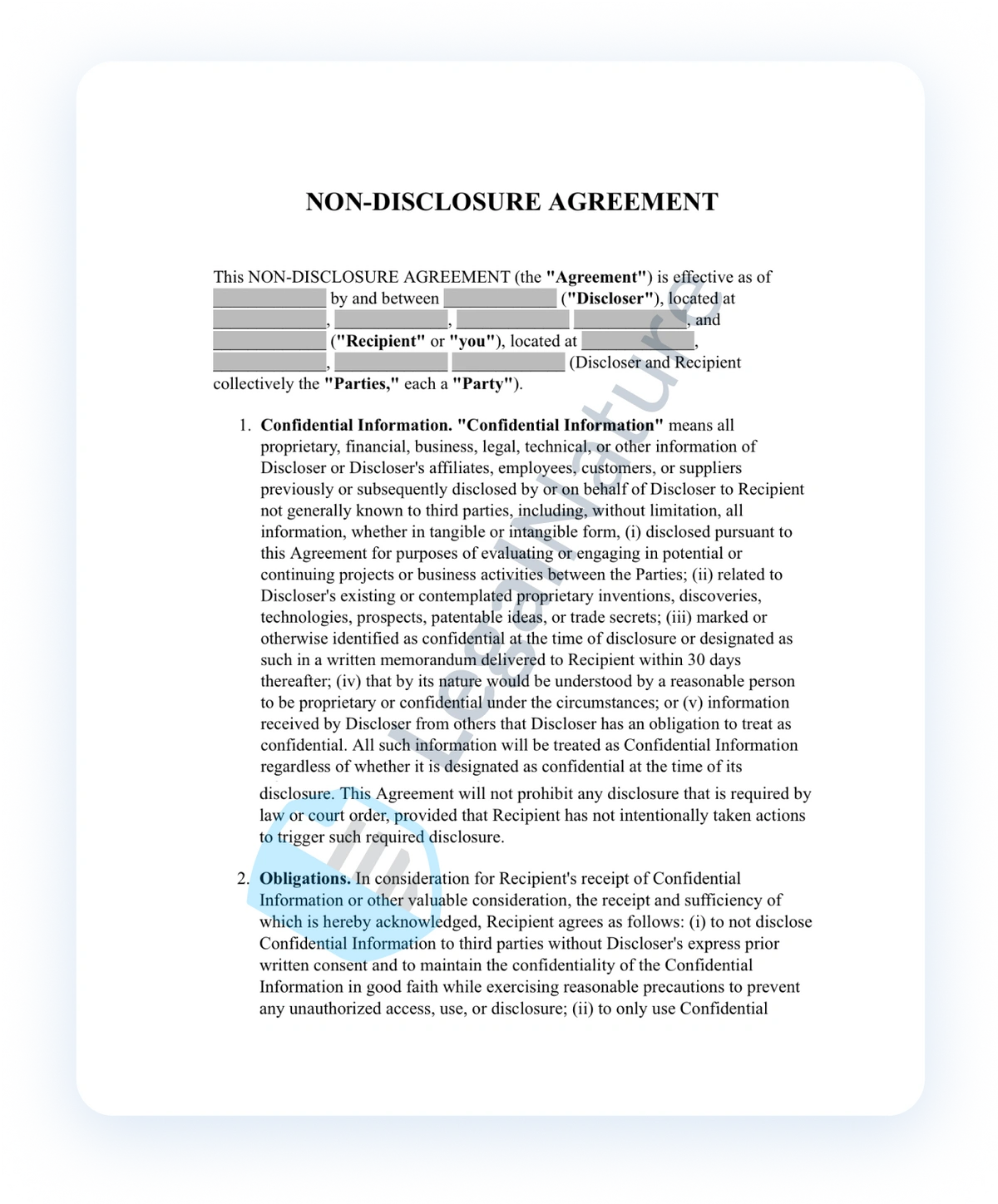
A non-disclosure agreement (NDA), also known as a confidentiality agreement, is a legally binding contract between two or more parties that establishes a confidential relationship and restricts the sharing of specific information with unauthorized third parties. NDAs are commonly used in business settings to protect sensitive information such as trade secrets, business plans, client lists, proprietary technology, and other confidential data.
Choose the type of NDA or confidentiality agreement that is right for you
Standard (Unilateral) Non-Disclosure Agreement A legally binding contract in which only one party discloses confidential information, and the other party is obligated to keep that information secret.
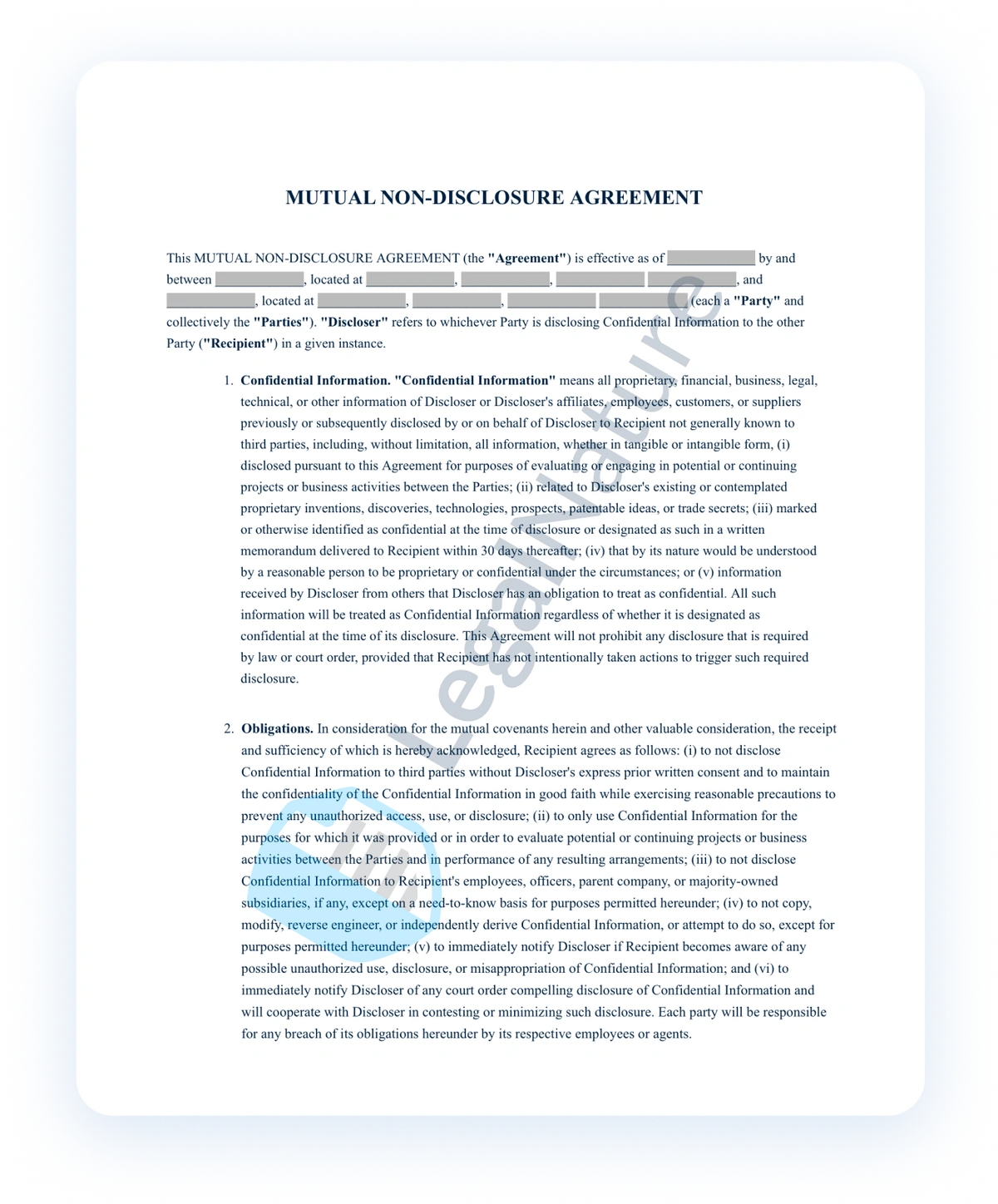
Mutual Non-Disclosure Agreement A legal contract where both parties agree to protect each other’s confidential information during a collaboration, negotiation, or partnership.
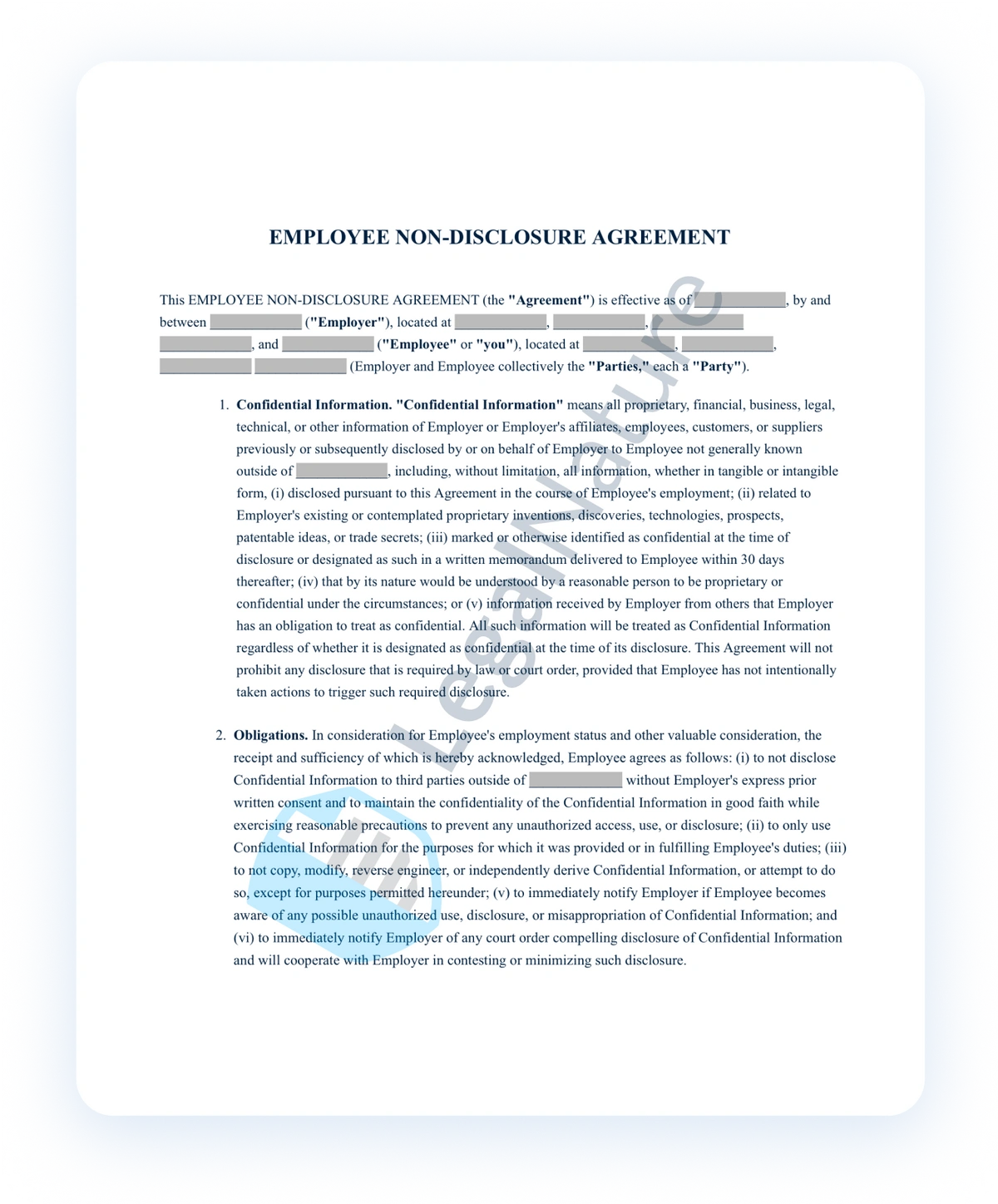
Employee Non-Disclosure Agreement A legally binding contract between an employer and employee that prohibits the unauthorized disclosure of confidential business information.
Create a non-disclosure agreement in your state
When to use a non-disclosure agreement
The primary purpose of an NDA is to ensure that confidential information shared between parties, such as during business negotiations, employment, or collaborations, remains protected from unauthorized disclosure or use. However, there are legal limitations. NDAs cannot be used to conceal illegal activities, and certain statutes (such as those related to whistle-blower protections or public policy) may limit their enforceability.
There are two commonly used types of NDAs:
- Unilateral NDA: requires a single party to keep information confidential
- Mutual NDA: sometimes referred to as a bilateral NDA, it requires both parties of the agreement to keep information confidential
How to create your non-disclosure agreement
Gather Information
Gather all the relevant information to complete your document. This may include party names, addresses, and confidential information that will be shared. It is advisable to determine what information may potentially be disclosed.
Answer Key Questions
Use the information you collected to complete your non-disclosure agreement. You will be guided through each step, allowing you to customize your document to match your specific needs. The questions and information presented to you dynamically change depending on your answers.
Review and Sign
It is always important to read your document thoroughly to ensure it matches your needs and is free of errors and omissions. After completing the questionnaire, you can make textual changes to your document by downloading it in Microsoft Word. If no changes are needed, you can simply download the PDF version and sign. These downloads are available by navigating to the Documents section of your account dashboard. When signing the document, be sure to follow any additional instructions related to signing and witnessing the document. Any such instructions will either be located next to the signature line or in the instructions attached at the end of the document. When using a notary, you must wait to sign the document until they are present, or utilize a Remote Online Notary service.
Distribute and Store Copies
At a minimum, all parties that sign the document should receive a copy once it is fully executed (everyone has signed). Be sure to store your copy in a safe location. It is a good idea to keep both a physical and electronic copy.
Why create a non-disclosure agreement?
Creating a non-disclosure agreement (NDA) serves as a strategic legal safeguard for businesses and individuals to protect sensitive information while enabling essential collaborations.
- Protect Trade Secrets and Proprietary Information: Prevent competitors or unauthorized parties from accessing critical assets like formulas, client lists, marketing strategies, or proprietary technology. This is especially vital during mergers, acquisitions, or investment discussions, where sensitive data must be shared to advance negotiations.
- Preserve Patent Rights: Publicly disclosed inventions risk losing patent eligibility. NDAs ensure confidentiality during development phases, safeguarding intellectual property rights.
- Define Confidential Information: Explicitly outline what constitutes protected information, reducing ambiguity and preventing accidental disclosures.
- Establish Legal Recourse: Breaching an NDA exposes parties to lawsuits, financial penalties, or injunctions. This legal framework deters misuse of sensitive data and provides remedies if violations occur.
- Set Employee Expectations: Employee NDAs clarify confidentiality obligations from onboarding, ensuring staff understand which data is protected (e.g., customer lists, internal processes) and the consequences of unauthorized sharing.
- Comply with Industry Standards: In sectors like tech, healthcare, or finance, NDAs are standard practice to meet regulatory requirements and protect client/data privacy.

Why choose LegalNature?
Non-disclosure agreement guide
Note that this help guide refers to two main parties: the disclosing party and the recipient of the confidential information. Depending upon the type of confidentiality agreement you create, these parties may instead be called the employer and employee or the employer and contractor.
Confidentiality
This agreement uses a comprehensive definition of "confidential information" and "trade secrets" to ensure any and all proprietary information remains well protected. The recipient is required to exercise the utmost diligence and his or her best efforts to guard and protect against unauthorized disclosure or theft of confidential information and trade secrets. If the recipient learns that someone else is making unauthorized disclosures, the recipient is required to notify the disclosing party.
Specific Confidential Information and Trade Secrets Protected
You have the option to specify the specific information that the contractor is required to keep confidential. This basically allows you to add your own classes of confidential information to the general definition included in the agreement. Including this information here may help clarify the expectations of the parties and support them should there ever be a dispute. Be sure to review the definitions of "confidential information" and "trade secrets" first to see whether they cover your needs.
Agreement Length
The recipient's duty of confidentiality can last as long as is needed for the parties' business purposes. Depending on the circumstances, the parties may agree on a length as short as a few months or may agree to make the duty last forever. It is best practice to limit the duration to as short as is necessary to protect the disclosing party's interests.
Disclaimer of Warranties
Most of the time it is a good idea to disclaim all warranties as to the confidential information and trade secrets. The main instance that you would not disclaim warranties is if the disclosing party has made express promises to the contractor that the information is correct and how the information will be used.
Dispute Resolution
It is usually recommended that you include a mediation and/or arbitration provision. This will require disputes to be settled through mediation or binding arbitration and avoid the time and expense of going through the formal court system.
Next, you will indicate which state's laws will govern the agreement. Usually, the disclosing party lists its principal place of business or residence as the governing state. Other options would be to use the disclosing party's state of incorporation or the state where the two parties are conducting any business together.
Additional Terms
You can add additional terms and conditions as desired. This allows you complete flexibility to tailor the document to reflect the specific situation and true intent of the parties, but be sure to preview the agreement first so that you know what has already been included.
Executing Your Agreement
- Have all parties sign and date the signature lines where indicated. Electronic signatures are allowed by the terms of the agreement. The parties can also sign copies sent to each other by email, fax, or other electronic means. If you include an arbitration provision, make sure that each party signs the arbitration exhibit.
- Notarization, if required, may be completed in person or through remote online notarization services.
- Make sure that all parties get a copy of the fully executed agreement.
- That's it! You can now rest assured that the disclosing party's confidential information will remain safe and secure.
Frequently asked questions
How long should a non-disclosure agreement last?
The length of a non-disclosure agreement (NDA) should be determined by what a reasonable time period is for the type of information that is being shared. If the NDA is too short, then you will not benefit from the maximum protection. If the NDA is set for too long a period, the other parties may be hesitant to sign it as it may interfere with future business plans. It is important to remember that an NDA only covers information that is not yet publicly known. Meaning, if the information you are trying to protect will go public, the length of the NDA should only extend until this time.
What are the different types of non-disclosure agreements?
Generally speaking, there are three types of non-disclosure agreements, but only two are typically used on a regular basis: unilateral and mutual. A unilateral NDA is used to bind only one party to the agreement to keep information confidential. This type is usually used when only one party is disclosing information and the other party is receiving information, such as with a contractor, employee, or investor. A mutual NDA is used when all parties expect that they will share information. Situations where this is common are business mergers or collaborative sales efforts.
When should an NDA be put in place?
An NDA should be executed as soon as possible and is often included alongside employment contracts. If an NDA is executed early, you can avoid any unintentional disclosures by the parties.
Can a non-disclosure agreement have more than two parties?
Yes. It is very common for NDAs to have multiple parties when a business deal involves multiple entities or when a party is using an agent.
What is a return clause?
Normally, information is transferred between parties. This could be shared files, access to computer systems, or work-product that have been created. A return clause stipulates that the receiving party will either return or destroy any of the information that they have received, ensuring that your confidential and proprietary information is protected.
What is the difference between non-disclosure, non-compete, and non-solicitation clauses?
A non-disclosure agreement prohibits the disclosure of confidential information to third parties, a non-compete agreement prohibits specific activities that compete with a business, and a non-solicitation clause prohibits solicitation of a business's customers, employees, or similar business relationships.
Also note, a non-circumvent clause is a similar term often appearing within non-disclosure agreements where one party is receiving confidential information related to a potential business transaction. The clause prohibits the recipient from pursuing or carrying out the transaction without the disclosing party's prior written consent. It also often prohibits the recipient from contacting other interested parties to the transaction. Essentially, this means the recipient may not cut the disclosing party out of the deal by attempting to transact with the other parties to the deal directly.
All of these terms commonly appear in business contracts and human resources forms, often in the same document. The clauses normally specify for how long and to which parties to the agreement they apply. Some state courts and legislatures have created laws that set limitations on these clauses, including how long, to whom, and even where (geographically) they may apply.
Create your non-disclosure agreement in minutes
Complete our form
;fill-opacity:1;'/%3e%3cpath%20fill-rule='evenodd'%20clip-rule='evenodd'%20d='M7.17816%205.46484C8.48591%205.46484%209.81742%206.23165%2011.1727%207.76529C10.8517%208.08628%2010.6467%208.28838%2010.5575%208.3716C10.4683%208.45482%2010.2514%208.6391%209.90659%208.92442C9.56182%209.20975%209.28244%209.40591%209.06844%209.51291C8.85445%209.6199%208.5721%209.73285%208.22138%209.85173C7.87067%209.97062%207.52293%2010.0301%207.17816%2010.0301C6.75017%2010.0301%206.35785%209.97656%206.00119%209.86957C5.64453%209.76257%205.28788%209.5783%204.93122%209.31675C4.57456%209.0552%204.29518%208.83229%204.09307%208.64801C3.89096%208.46374%203.58781%208.16355%203.18359%207.74745C3.95636%206.97469%204.64291%206.40107%205.24329%206.02658C5.84367%205.65209%206.48862%205.46484%207.17816%205.46484ZM7.17816%209.37024C7.61804%209.37024%207.9955%209.20975%208.31055%208.88876C8.6256%208.56776%208.78312%208.18733%208.78312%207.74745C8.78312%207.30757%208.6256%206.92714%208.31055%206.60615C7.9955%206.28516%207.61804%206.12466%207.17816%206.12466C6.73828%206.12466%206.36082%206.28516%206.04577%206.60615C5.73072%206.92714%205.5732%207.30757%205.5732%207.74745C5.5732%208.18733%205.73072%208.56776%206.04577%208.88876C6.36082%209.20975%206.73828%209.37024%207.17816%209.37024ZM7.17816%207.1768C7.17816%207.34324%207.23166%207.47996%207.33865%207.58696C7.44565%207.69395%207.58237%207.74745%207.74881%207.74745C7.8677%207.74745%207.98658%207.70584%208.10547%207.62262V7.74745C8.10547%208.009%208.01631%208.23191%207.83798%208.41619C7.65965%208.60046%207.43971%208.6926%207.17816%208.6926C6.91661%208.6926%206.69667%208.60046%206.51834%208.41619C6.34001%208.23191%206.25085%208.009%206.25085%207.74745C6.25085%207.4859%206.34001%207.26299%206.51834%207.07872C6.69667%206.89444%206.91661%206.80231%207.17816%206.80231H7.32082C7.22571%206.9212%207.17816%207.04603%207.17816%207.1768Z'%20fill='white'%20style='fill:white;fill-opacity:1;'/%3e%3c/svg%3e)
Preview and download your document
;fill-opacity:1;'/%3e%3cg%20clip-path='url(%23clip0_10486_8655)'%3e%3cpath%20d='M10.8931%205.49519C10.8004%205.45343%2010.6879%205.48908%2010.6427%205.57565L10.4595%205.92398L10.3128%205.85879L10.5058%205.49212L10.5069%205.48906C10.508%205.48703%2010.5091%205.48397%2010.5103%205.48194C10.54%205.4137%2010.5743%205.33324%2010.5864%205.24258C10.6239%204.97267%2010.5125%204.68749%2010.2874%204.47869C10.0733%204.28007%209.74562%204.16804%209.43445%204.18534C9.36934%204.18942%209.29984%204.20062%209.22812%204.21998C9.11446%204.25053%209.00302%204.30349%208.8982%204.37785C8.82316%204.4308%208.71833%204.52146%208.64661%204.64877L8.64551%204.65184L8.64441%204.65387L7.9603%205.95657C7.95698%205.96166%207.95369%205.96675%207.95037%205.97286C7.94705%205.97795%207.94485%205.98406%207.94265%205.99017L6.17057%209.36151C6.14408%209.41244%206.13085%209.46947%206.13305%209.5265V9.52752L6.17277%2010.6143C6.17718%2010.7202%206.22022%2010.819%206.29194%2010.8964L6.18712%2011.0919C6.14078%2011.1775%206.1794%2011.2814%206.27207%2011.3242C6.29856%2011.3364%206.32724%2011.3425%206.35483%2011.3425C6.42435%2011.3425%206.49056%2011.3069%206.52366%2011.2458L6.62516%2011.0553C6.64061%2011.0563%206.65495%2011.0573%206.6704%2011.0573C6.77412%2011.0573%206.87673%2011.0278%206.9628%2010.9687L7.91392%2010.325C7.93379%2010.3118%207.95254%2010.2955%207.96909%2010.2792C7.97241%2010.2761%207.97461%2010.2731%207.97793%2010.27C7.9989%2010.2476%208.01655%2010.2222%208.0309%2010.1957L10.1483%206.16942L10.2951%206.23461L9.35169%208.02823C9.30645%208.11379%209.34507%208.21768%209.43886%208.25943C9.46535%208.27165%209.49293%208.27674%209.52052%208.27674C9.59004%208.27674%209.65735%208.24109%209.68935%208.17896L10.7023%206.25293C10.7078%206.24581%2010.7133%206.23766%2010.7177%206.2295C10.7222%206.22134%2010.7244%206.21422%2010.7277%206.20606L10.9804%205.72533C11.0255%205.64082%2010.9858%205.53694%2010.8931%205.49519ZM6.73994%2010.6907C6.70574%2010.7131%206.6627%2010.7182%206.62408%2010.7049C6.61857%2010.7019%206.61305%2010.6988%206.60643%2010.6958C6.60312%2010.6948%206.60092%2010.6937%206.5976%2010.6927C6.5656%2010.6723%206.54575%2010.6398%206.54463%2010.6041L6.51814%209.89623C6.76641%2010.0745%207.05219%2010.2028%207.35673%2010.2741L6.73994%2010.6907Z'%20fill='white'%20style='fill:white;fill-opacity:1;'/%3e%3cpath%20d='M5.59896%2011.03C5.55151%2011.029%205.49634%2011.03%205.43897%2011.03C5.13885%2011.0331%204.57941%2011.0382%204.40067%2010.8538C4.36976%2010.8222%204.33005%2010.7652%204.3444%2010.647C4.38634%2010.314%204.58935%209.96362%204.76811%209.65499L4.79789%209.60305C4.85638%209.50221%204.91707%209.40036%204.97664%209.30056C5.14766%209.01537%205.32421%208.72%205.46433%208.40935C5.56806%208.18018%205.62542%207.96426%205.63536%207.7697C5.64859%207.50897%205.57799%207.28183%205.42571%207.09441C5.24365%206.86932%204.97774%206.70431%204.61361%206.58821C4.31128%206.49145%203.97806%206.44154%203.68455%206.39672C3.55215%206.37635%203.42635%206.35801%203.3105%206.33561C3.20899%206.31626%203.10969%206.37737%203.08982%206.47108C3.06885%206.56478%203.13505%206.65645%203.23658%206.67479C3.36015%206.69822%203.48926%206.71756%203.62497%206.73793C4.18219%206.82248%204.81444%206.91719%205.1256%207.30118C5.30986%207.52832%205.30766%207.85628%205.11788%208.2759C4.98547%208.56925%204.81444%208.85545%204.64783%209.13248C4.58825%209.23231%204.52646%209.33619%204.46687%209.43905L4.43709%209.48998C4.2418%209.82609%204.02111%2010.207%203.97146%2010.6053C3.9472%2010.7957%203.99795%2010.9567%204.12152%2011.084C4.38082%2011.3498%204.8939%2011.3763%205.29223%2011.3763C5.34408%2011.3763%205.39485%2011.3763%205.44229%2011.3753C5.49855%2011.3753%205.55043%2011.3743%205.59456%2011.3753C5.59566%2011.3753%205.59566%2011.3753%205.59676%2011.3753C5.69939%2011.3753%205.78324%2011.2989%205.78434%2011.2041C5.78544%2011.1105%205.70266%2011.031%205.59896%2011.03Z'%20fill='white'%20style='fill:white;fill-opacity:1;'/%3e%3c/g%3e%3cdefs%3e%3cclipPath%20id='clip0_10486_8655'%3e%3crect%20width='7.91304'%20height='7.30435'%20fill='white'%20style='fill:white;fill-opacity:1;'%20transform='translate(3.08594%204.12891)'/%3e%3c/clipPath%3e%3c/defs%3e%3c/svg%3e)
Review and sign your document
