


Do Not Resuscitate (DNR) Order
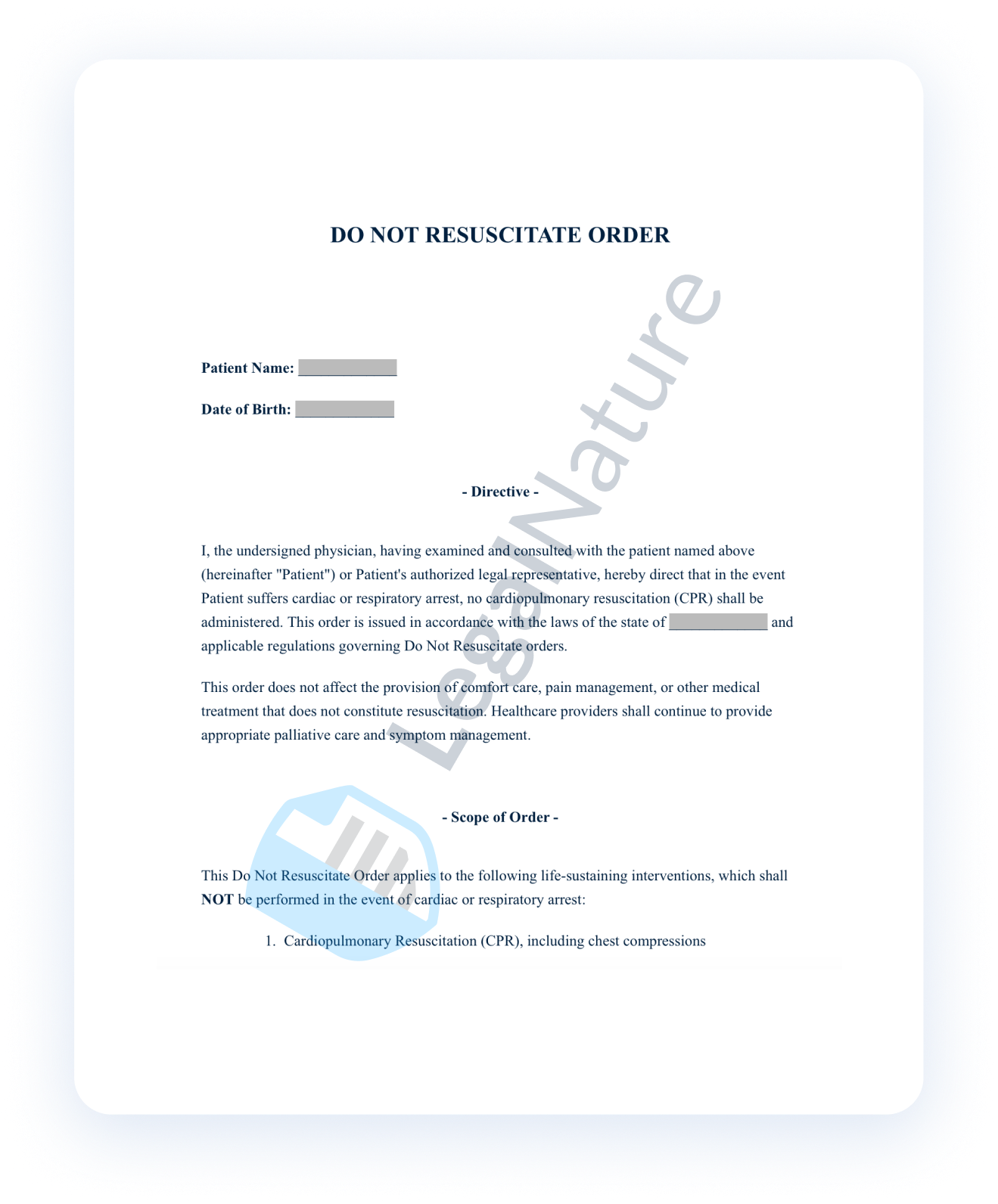
A do not resuscitate order, commonly called a DNR, is a medical directive that instructs healthcare providers not to attempt resuscitation interventions if your heart stops beating or you stop breathing.
Select a state


What is a do not resuscitate order?
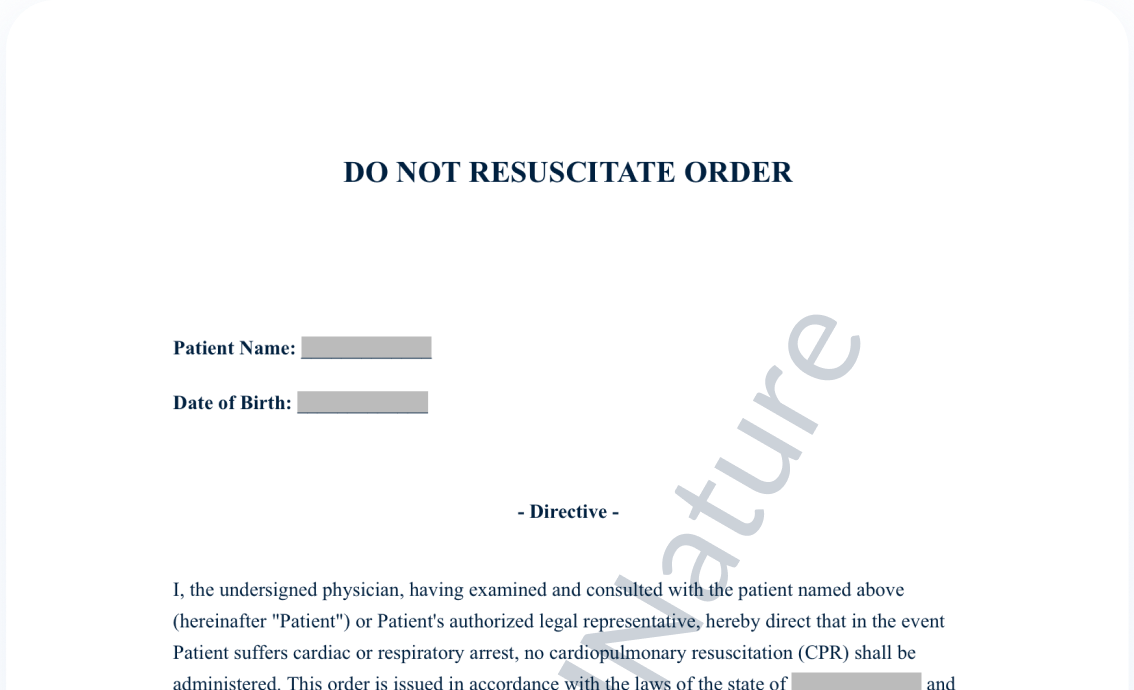
A do not resuscitate order is a physician-authorized medical directive that communicates your decision to decline CPR in the event your heart or breathing stops. It is one of several advance care planning documents that allow you to make your medical wishes known before a crisis occurs so that doctors, nurses, and emergency responders are not left guessing.
CPR includes a range of interventions: chest compressions, electric shock (defibrillation), breathing tubes, and mechanical ventilation. While CPR can be lifesaving in some situations, it is often unsuccessful in patients with serious illness or advanced age, and it can cause significant physical trauma. A DNR order allows you to weigh those realities in advance and make a deliberate, informed choice.
To be valid, a DNR order must be signed by the patient (or the patient's legal representative, such as a healthcare power of attorney agent) and by a licensed physician. The completed document is placed in the patient's medical record and, in many states, should also be kept in a visible location at home, such as on the refrigerator, so that emergency medical technicians can find it quickly.
A DNR order takes effect the moment it is properly signed and placed in your medical record. It does not require a separate activation step or a terminal diagnosis.
DNR orders are sometimes called "no code" orders within hospital settings, or "allow natural death" (AND) orders—a term some healthcare providers prefer because it frames the directive around comfort and dignity rather than refusal of treatment. All three terms describe the same legal and medical instruction.
State law governs the exact form, witness requirements, and scope of a DNR order. LegalNature's state-specific forms are built to meet the requirements of all 50 states and the District of Columbia.
Finish your advance care plan with these related documents
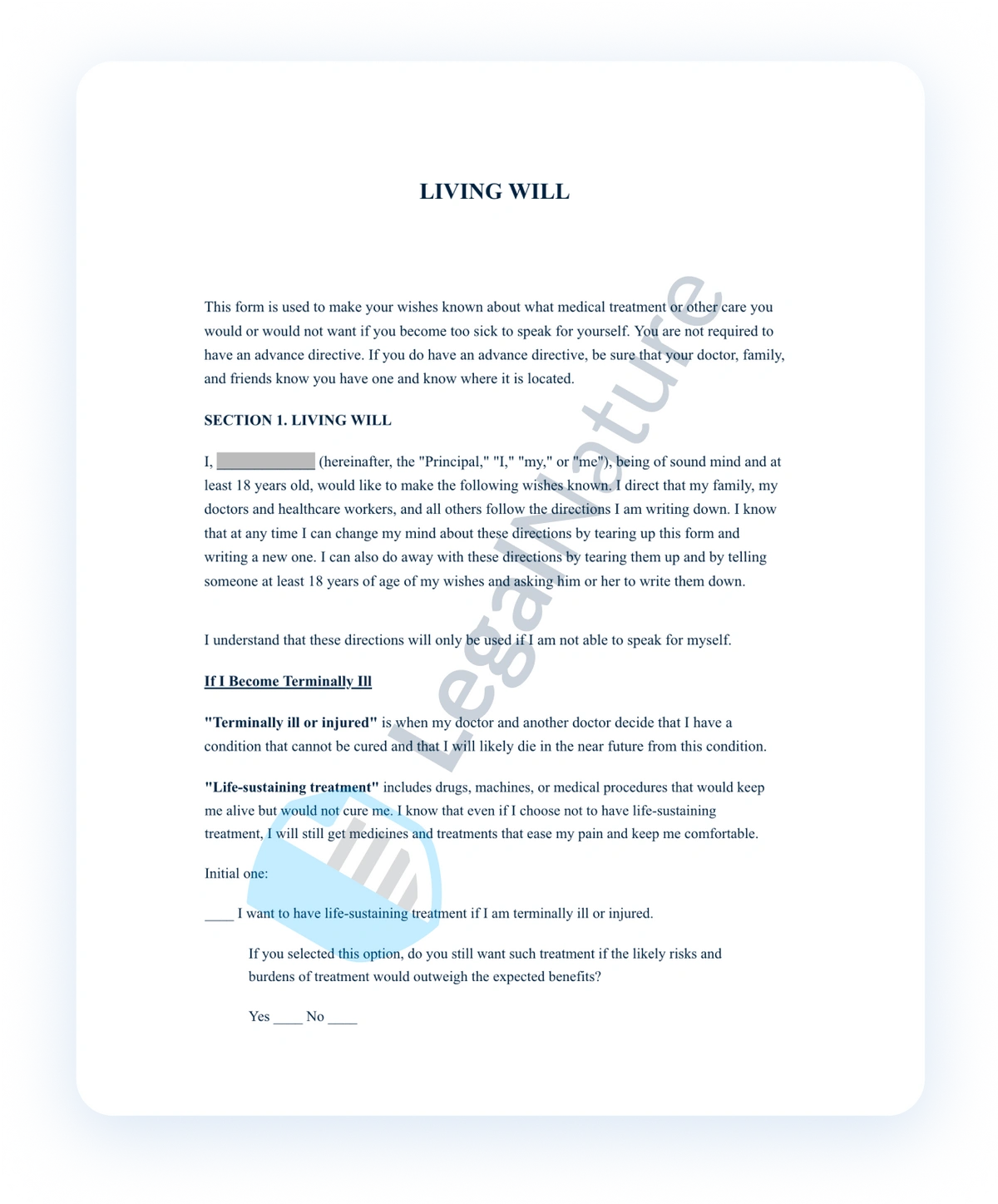
Living Will A living will documents your broader wishes about life-sustaining treatment, including mechanical ventilation, feeding tubes, and dialysis, in the event you cannot speak for yourself. It works alongside a DNR order, not instead of it.
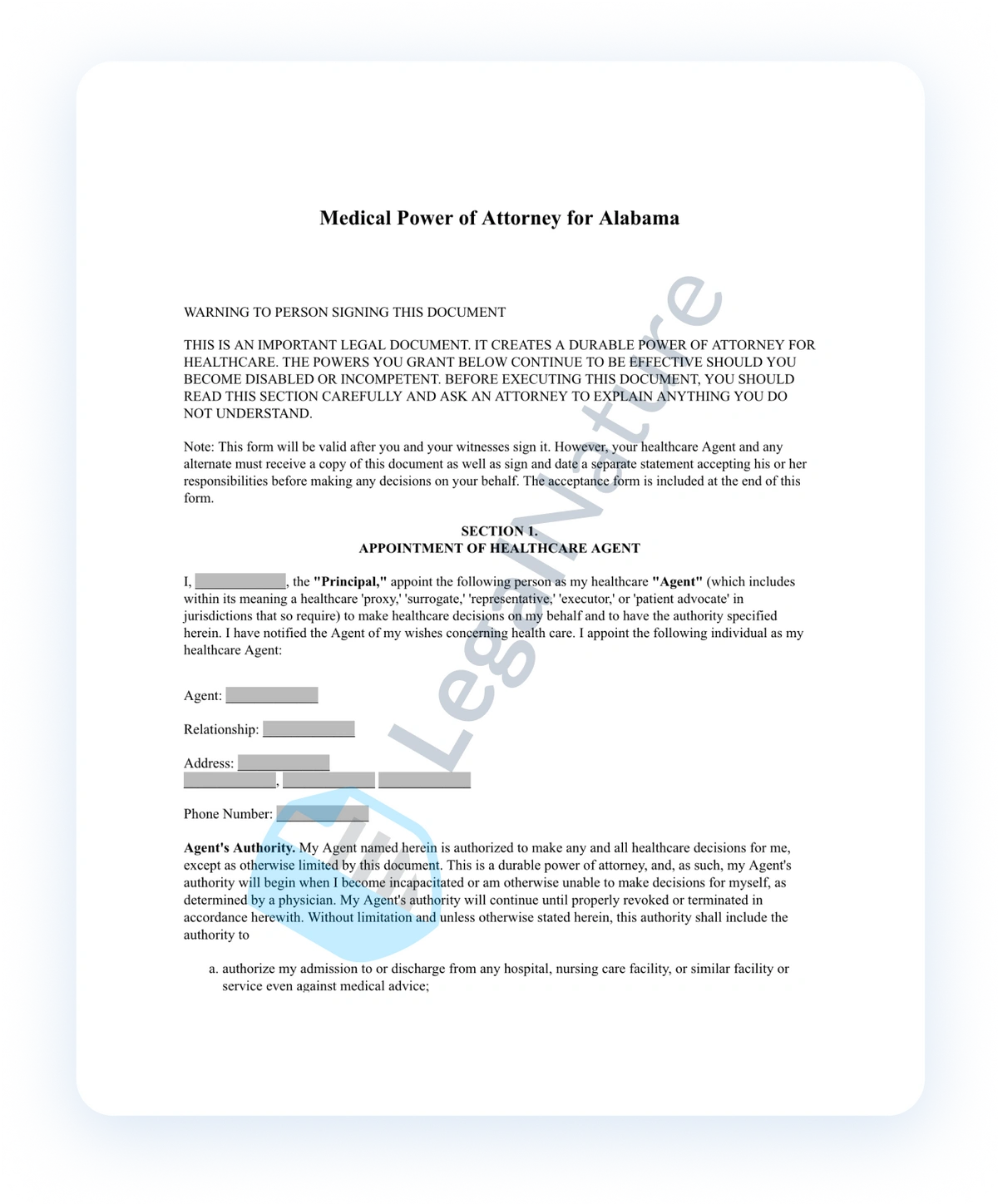
Medical Power of Attorney A medical, or healthcare, power of attorney appoints a trusted person to make medical decisions on your behalf if you become incapacitated. Your agent can communicate your DNR wishes and advocate for your care preferences across all treatment decisions.
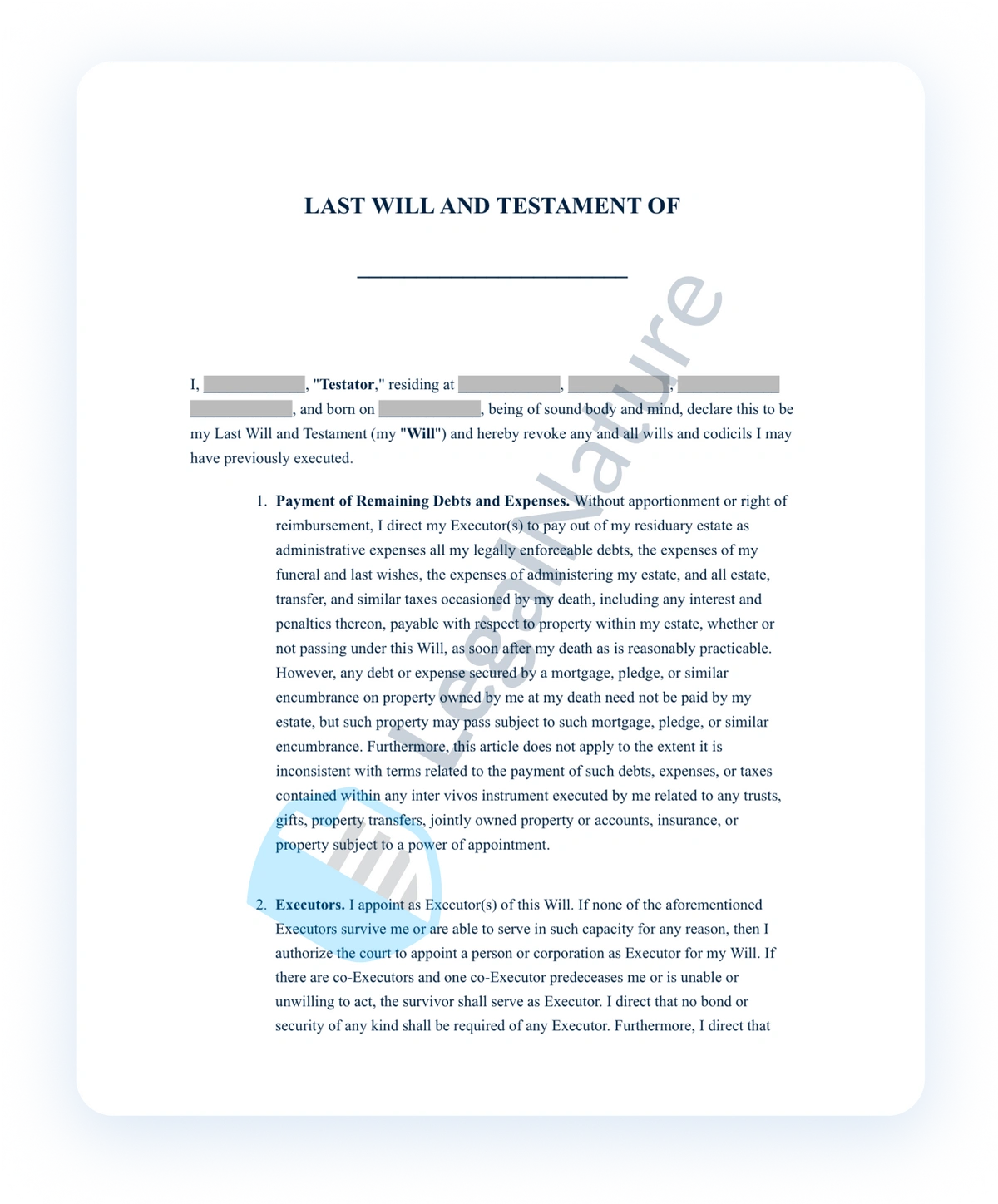
Last Will and Testament A last will and testament directs how your property is distributed after your death and allows you to name a guardian for minor children. While a will does not govern medical decisions, it is a foundational estate planning document that works in concert with your advance directives.
Types of DNR orders
The type of DNR order that applies to you depends on where you receive care, when the DNR is created, and the scope of resuscitation decisions you want to address. LegalNature's DNR form can be applied generally and are state compliant in all 50 states and the District of Columbia.
In-Hospital DNR Order An in-hospital DNR instructs the hospital care team not to perform CPR during an inpatient stay. It is documented in your hospital chart and applies only within that facility. If you are discharged, the order does not automatically travel with you.
Out-of-Hospital DNR Order An out-of-hospital DNR—sometimes called a prehospital DNR—applies outside of hospital settings. It directs emergency medical technicians (EMTs) and first responders not to initiate CPR if called to your home, a nursing facility, or another community location. This is the form most relevant for patients managing serious illness at home or in hospice care.
Create a DNR order in your state.
When do you need a DNR order?
A DNR order is not only for patients who are terminally ill. Anyone who has strong feelings about resuscitation, regardless of age or current health, may consider putting a DNR in place as part of thoughtful advance care planning.
The following circumstances most commonly prompt people to create a DNR order:
- Serious or terminal illness. Patients with cancer, heart failure, advanced COPD, or other life-limiting conditions often discuss a DNR with their physician as part of a broader care plan.
- Advanced age. Older adults who understand that CPR carries significant risks and a low success rate in elderly populations may choose a DNR as a matter of personal preference and dignity.
- Hospice enrollment. Hospice care is built around comfort rather than curative treatment. A DNR is standard practice—though not legally required—for patients receiving hospice services.
- Personal values. Some individuals hold religious, philosophical, or personal beliefs that align with allowing natural death. A DNR formalizes those values in a legally recognized document.
- Prior resuscitation experience. Patients or family members who have witnessed or experienced unsuccessful CPR sometimes choose a DNR in light of that experience.
You do not need to be in a medical crisis to create a DNR order. In fact, the document is most useful when it is in place well before an emergency occurs.
A conversation with your physician is an important first step. Your doctor can help you understand your prognosis, the realistic outcomes of CPR given your specific condition, and the options available in your state.
DNR order vs. living will: what's the difference?
A DNR order and a living will are both advance care planning documents, but they serve different functions and operate through different legal mechanisms.
A living will expresses your general wishes about end-of-life care; a DNR order is a specific, immediately enforceable medical instruction about CPR.
A living will does not replace a DNR order, and a DNR order does not replace a living will. Many people complete both documents as part of a broader estate and healthcare planning strategy. The living will communicates your values and broader treatment preferences; the DNR order gives care providers a clear, actionable instruction they can follow without waiting for further interpretation.
If you have named a medical power of attorney agent, that person may have authority to request a DNR order on your behalf if you become incapacitated, but only if your state law and your POA document permit it. Consulting with an attorney is recommended if you have questions about the scope of your agent's authority.
How to create a DNR order
1. Discuss Your Wishes With Your Physician
Your doctor will want to understand your medical history, current condition, and reasons for requesting a DNR. This conversation also ensures you understand what CPR involves and what outcomes are realistic given your health.
2. Identify the Correct Form for Your State
DNR requirements vary by state. Some states have a standardized statutory form; others accept physician-drafted orders. LegalNature's platform generates the correct state-specific form automatically based on your location.
3. Complete the Patient, Physician, and Witness Information Sections
Provide the name, date of birth, and address of each signing party. Physicians should also include their license number to verify their accreditation.
4. Sign the Document in Accordance With Your State's Requirements
Most states require the patient's signature (or the signature of a legal representative) and the signature of a licensed physician. Some states require witness signatures as well. LegalNature's form allows you to choose three options for executing the document.
5. Place the Signed DNR Where Care Providers Can Find It
In a hospital or nursing facility, the form goes into your medical record. At home, keep the original in a visible location—many states recommend the refrigerator door or near the front entrance—and give copies to your physician, any named healthcare agent, and close family members.

Why choose LegalNature?
Do not resuscitate help guide
A do not resuscitate order is one of the most personal documents in advance care planning, and one of the most misunderstood. This guide synthesizes the key points from this page and addresses terminology and distinctions that frequently cause confusion.
What a DNR Order Actually Does (and Doesn't Do)
A DNR order does one thing: it instructs care providers not to perform CPR if your heart or breathing stops. It does not suspend all treatment, accelerate death, or override your other medical wishes. Every other intervention—pain relief, surgery, antibiotics, comfort care—remains fully available unless you have separately addressed it in a living will or POLST form. The document's narrow scope is a feature, not a limitation. It allows you to make one high-stakes decision clearly without affecting anything else.
"DNR," "No Code," and "Allow Natural Death" — The Same Instruction
You may encounter different terms depending on where you receive care. "DNR," "no code," and "allow natural death" (AND) all describe the same medical instruction: do not attempt CPR. Hospital staff often use "no code" in clinical settings; some providers and patient advocates prefer "allow natural death" because it emphasizes comfort and dignity rather than refusal. All three terms carry the same legal and medical weight when documented in a properly executed order. If your physician or care facility uses different language than you expect, ask for clarification. The underlying instruction should be identical.
In-Hospital vs. Out-of-Hospital: The Distinction That Matters Most
The single most important practical question about a DNR order is where it applies. An in-hospital DNR lives in your chart and governs your care team within that facility only. An out-of-hospital DNR travels with you; it is the form that emergency responders, home health aides, and nursing facility staff can act on outside of a hospital. If you are managing serious illness at home or enrolled in hospice, an out-of-hospital DNR is the operative document. Many patients need both. LegalNature's document is applicable to both situations.
How a DNR Fits Into a Complete Advance Care Plan
A DNR order works best as part of a coordinated set of documents. Here is a useful way to think about the relationship:
- Your last will and testament addresses what happens to your property after death.
- Your medical power of attorney designates who speaks for you if you cannot speak for yourself.
- Your living will communicates your broader preferences about life-sustaining treatment.
- Your DNR order gives care providers one specific, immediately actionable instruction about CPR.
No single document does all of these jobs. Each fills a distinct gap, and the absence of any one of them can leave your family or care team without the guidance they need.
State Law Governs the Details
DNR requirements are not uniform across states. The required form, witness rules, physician authorization process, and EMS recognition standards all vary. A DNR executed in one state is not automatically valid in another. If you move, spend extended time in a second state, or are admitted to a facility in a different state than where your DNR was signed, work with your physician to execute a new state-compliant order. LegalNature's platform generates state-specific DNR forms for all 50 states and the District of Columbia to make that process straightforward.
Frequently asked questions
What does DNR stand for?
DNR stands for "do not resuscitate." A DNR order is a medical directive that instructs healthcare providers not to perform CPR—including chest compressions, defibrillation, or mechanical breathing assistance—if a patient's heart or breathing stops.
Is a DNR order the same as a living will?
No. A living will is a legal advance directive that expresses your general wishes about end-of-life care across a range of medical decisions. A DNR order is a specific, physician-signed medical order that applies to CPR only. Both documents serve important and complementary roles in advance care planning.
Does a DNR mean you will receive no medical treatment?
No. A DNR order applies only to CPR. All other medical care—including pain management, antibiotics, surgery, and comfort care—remains available unless you have separately addressed those decisions in a living will.
Who can sign a DNR order?
In most states, a DNR order must be signed by the patient and a licensed physician. If the patient lacks decision-making capacity, an authorized representative, such as a medical power of attorney agent or legal guardian, may sign on the patient's behalf, subject to state law requirements.
Can a DNR order be revoked?
Yes. A competent adult can revoke a DNR order at any time, orally or in writing. If you revoke your DNR, notify your physician immediately and retrieve or destroy any copies on file.
Does a DNR order expire?
DNR orders generally do not expire on their own, but requirements vary by state. Some states require periodic physician review and reauthorization, particularly for out-of-hospital DNR orders. Review your DNR regularly and after any significant change in health or location.
Does a DNR order transfer between states?
Not automatically. DNR orders are governed by state law, and a DNR executed in one state may not be recognized in another. If you move or spend significant time in another state, work with your physician to execute a new state-compliant DNR order. LegalNature's platform generates state-specific forms to help with this process.
What is the difference between a DNR and a POLST?
A DNR order covers CPR only. A POLST (Physician Orders for Life-Sustaining Treatment) is a broader portable medical order that covers CPR, mechanical ventilation, artificial nutrition, and hospitalization preferences. A POLST is generally used for patients with serious illness or frailty who need a comprehensive, portable record of their care instructions.
Is a DNR order legally binding on emergency responders?
An out-of-hospital DNR order is legally binding on EMTs and first responders in most states, provided the form is properly executed and visible at the scene. An in-hospital DNR applies only within the facility where it is on file. Requirements vary by state.
Create your DNR order in minutes
Complete our form
;fill-opacity:1;'/%3e%3cpath%20fill-rule='evenodd'%20clip-rule='evenodd'%20d='M7.17816%205.46484C8.48591%205.46484%209.81742%206.23165%2011.1727%207.76529C10.8517%208.08628%2010.6467%208.28838%2010.5575%208.3716C10.4683%208.45482%2010.2514%208.6391%209.90659%208.92442C9.56182%209.20975%209.28244%209.40591%209.06844%209.51291C8.85445%209.6199%208.5721%209.73285%208.22138%209.85173C7.87067%209.97062%207.52293%2010.0301%207.17816%2010.0301C6.75017%2010.0301%206.35785%209.97656%206.00119%209.86957C5.64453%209.76257%205.28788%209.5783%204.93122%209.31675C4.57456%209.0552%204.29518%208.83229%204.09307%208.64801C3.89096%208.46374%203.58781%208.16355%203.18359%207.74745C3.95636%206.97469%204.64291%206.40107%205.24329%206.02658C5.84367%205.65209%206.48862%205.46484%207.17816%205.46484ZM7.17816%209.37024C7.61804%209.37024%207.9955%209.20975%208.31055%208.88876C8.6256%208.56776%208.78312%208.18733%208.78312%207.74745C8.78312%207.30757%208.6256%206.92714%208.31055%206.60615C7.9955%206.28516%207.61804%206.12466%207.17816%206.12466C6.73828%206.12466%206.36082%206.28516%206.04577%206.60615C5.73072%206.92714%205.5732%207.30757%205.5732%207.74745C5.5732%208.18733%205.73072%208.56776%206.04577%208.88876C6.36082%209.20975%206.73828%209.37024%207.17816%209.37024ZM7.17816%207.1768C7.17816%207.34324%207.23166%207.47996%207.33865%207.58696C7.44565%207.69395%207.58237%207.74745%207.74881%207.74745C7.8677%207.74745%207.98658%207.70584%208.10547%207.62262V7.74745C8.10547%208.009%208.01631%208.23191%207.83798%208.41619C7.65965%208.60046%207.43971%208.6926%207.17816%208.6926C6.91661%208.6926%206.69667%208.60046%206.51834%208.41619C6.34001%208.23191%206.25085%208.009%206.25085%207.74745C6.25085%207.4859%206.34001%207.26299%206.51834%207.07872C6.69667%206.89444%206.91661%206.80231%207.17816%206.80231H7.32082C7.22571%206.9212%207.17816%207.04603%207.17816%207.1768Z'%20fill='white'%20style='fill:white;fill-opacity:1;'/%3e%3c/svg%3e)
Preview and download your document
;fill-opacity:1;'/%3e%3cg%20clip-path='url(%23clip0_10486_8655)'%3e%3cpath%20d='M10.8931%205.49519C10.8004%205.45343%2010.6879%205.48908%2010.6427%205.57565L10.4595%205.92398L10.3128%205.85879L10.5058%205.49212L10.5069%205.48906C10.508%205.48703%2010.5091%205.48397%2010.5103%205.48194C10.54%205.4137%2010.5743%205.33324%2010.5864%205.24258C10.6239%204.97267%2010.5125%204.68749%2010.2874%204.47869C10.0733%204.28007%209.74562%204.16804%209.43445%204.18534C9.36934%204.18942%209.29984%204.20062%209.22812%204.21998C9.11446%204.25053%209.00302%204.30349%208.8982%204.37785C8.82316%204.4308%208.71833%204.52146%208.64661%204.64877L8.64551%204.65184L8.64441%204.65387L7.9603%205.95657C7.95698%205.96166%207.95369%205.96675%207.95037%205.97286C7.94705%205.97795%207.94485%205.98406%207.94265%205.99017L6.17057%209.36151C6.14408%209.41244%206.13085%209.46947%206.13305%209.5265V9.52752L6.17277%2010.6143C6.17718%2010.7202%206.22022%2010.819%206.29194%2010.8964L6.18712%2011.0919C6.14078%2011.1775%206.1794%2011.2814%206.27207%2011.3242C6.29856%2011.3364%206.32724%2011.3425%206.35483%2011.3425C6.42435%2011.3425%206.49056%2011.3069%206.52366%2011.2458L6.62516%2011.0553C6.64061%2011.0563%206.65495%2011.0573%206.6704%2011.0573C6.77412%2011.0573%206.87673%2011.0278%206.9628%2010.9687L7.91392%2010.325C7.93379%2010.3118%207.95254%2010.2955%207.96909%2010.2792C7.97241%2010.2761%207.97461%2010.2731%207.97793%2010.27C7.9989%2010.2476%208.01655%2010.2222%208.0309%2010.1957L10.1483%206.16942L10.2951%206.23461L9.35169%208.02823C9.30645%208.11379%209.34507%208.21768%209.43886%208.25943C9.46535%208.27165%209.49293%208.27674%209.52052%208.27674C9.59004%208.27674%209.65735%208.24109%209.68935%208.17896L10.7023%206.25293C10.7078%206.24581%2010.7133%206.23766%2010.7177%206.2295C10.7222%206.22134%2010.7244%206.21422%2010.7277%206.20606L10.9804%205.72533C11.0255%205.64082%2010.9858%205.53694%2010.8931%205.49519ZM6.73994%2010.6907C6.70574%2010.7131%206.6627%2010.7182%206.62408%2010.7049C6.61857%2010.7019%206.61305%2010.6988%206.60643%2010.6958C6.60312%2010.6948%206.60092%2010.6937%206.5976%2010.6927C6.5656%2010.6723%206.54575%2010.6398%206.54463%2010.6041L6.51814%209.89623C6.76641%2010.0745%207.05219%2010.2028%207.35673%2010.2741L6.73994%2010.6907Z'%20fill='white'%20style='fill:white;fill-opacity:1;'/%3e%3cpath%20d='M5.59896%2011.03C5.55151%2011.029%205.49634%2011.03%205.43897%2011.03C5.13885%2011.0331%204.57941%2011.0382%204.40067%2010.8538C4.36976%2010.8222%204.33005%2010.7652%204.3444%2010.647C4.38634%2010.314%204.58935%209.96362%204.76811%209.65499L4.79789%209.60305C4.85638%209.50221%204.91707%209.40036%204.97664%209.30056C5.14766%209.01537%205.32421%208.72%205.46433%208.40935C5.56806%208.18018%205.62542%207.96426%205.63536%207.7697C5.64859%207.50897%205.57799%207.28183%205.42571%207.09441C5.24365%206.86932%204.97774%206.70431%204.61361%206.58821C4.31128%206.49145%203.97806%206.44154%203.68455%206.39672C3.55215%206.37635%203.42635%206.35801%203.3105%206.33561C3.20899%206.31626%203.10969%206.37737%203.08982%206.47108C3.06885%206.56478%203.13505%206.65645%203.23658%206.67479C3.36015%206.69822%203.48926%206.71756%203.62497%206.73793C4.18219%206.82248%204.81444%206.91719%205.1256%207.30118C5.30986%207.52832%205.30766%207.85628%205.11788%208.2759C4.98547%208.56925%204.81444%208.85545%204.64783%209.13248C4.58825%209.23231%204.52646%209.33619%204.46687%209.43905L4.43709%209.48998C4.2418%209.82609%204.02111%2010.207%203.97146%2010.6053C3.9472%2010.7957%203.99795%2010.9567%204.12152%2011.084C4.38082%2011.3498%204.8939%2011.3763%205.29223%2011.3763C5.34408%2011.3763%205.39485%2011.3763%205.44229%2011.3753C5.49855%2011.3753%205.55043%2011.3743%205.59456%2011.3753C5.59566%2011.3753%205.59566%2011.3753%205.59676%2011.3753C5.69939%2011.3753%205.78324%2011.2989%205.78434%2011.2041C5.78544%2011.1105%205.70266%2011.031%205.59896%2011.03Z'%20fill='white'%20style='fill:white;fill-opacity:1;'/%3e%3c/g%3e%3cdefs%3e%3cclipPath%20id='clip0_10486_8655'%3e%3crect%20width='7.91304'%20height='7.30435'%20fill='white'%20style='fill:white;fill-opacity:1;'%20transform='translate(3.08594%204.12891)'/%3e%3c/clipPath%3e%3c/defs%3e%3c/svg%3e)
Review and sign your document
