


Transfer on Death Deed
A transfer on death deed lets you pass real estate directly to a beneficiary when you die, and avoid probate.
Select a state


What is a transfer on death deed?
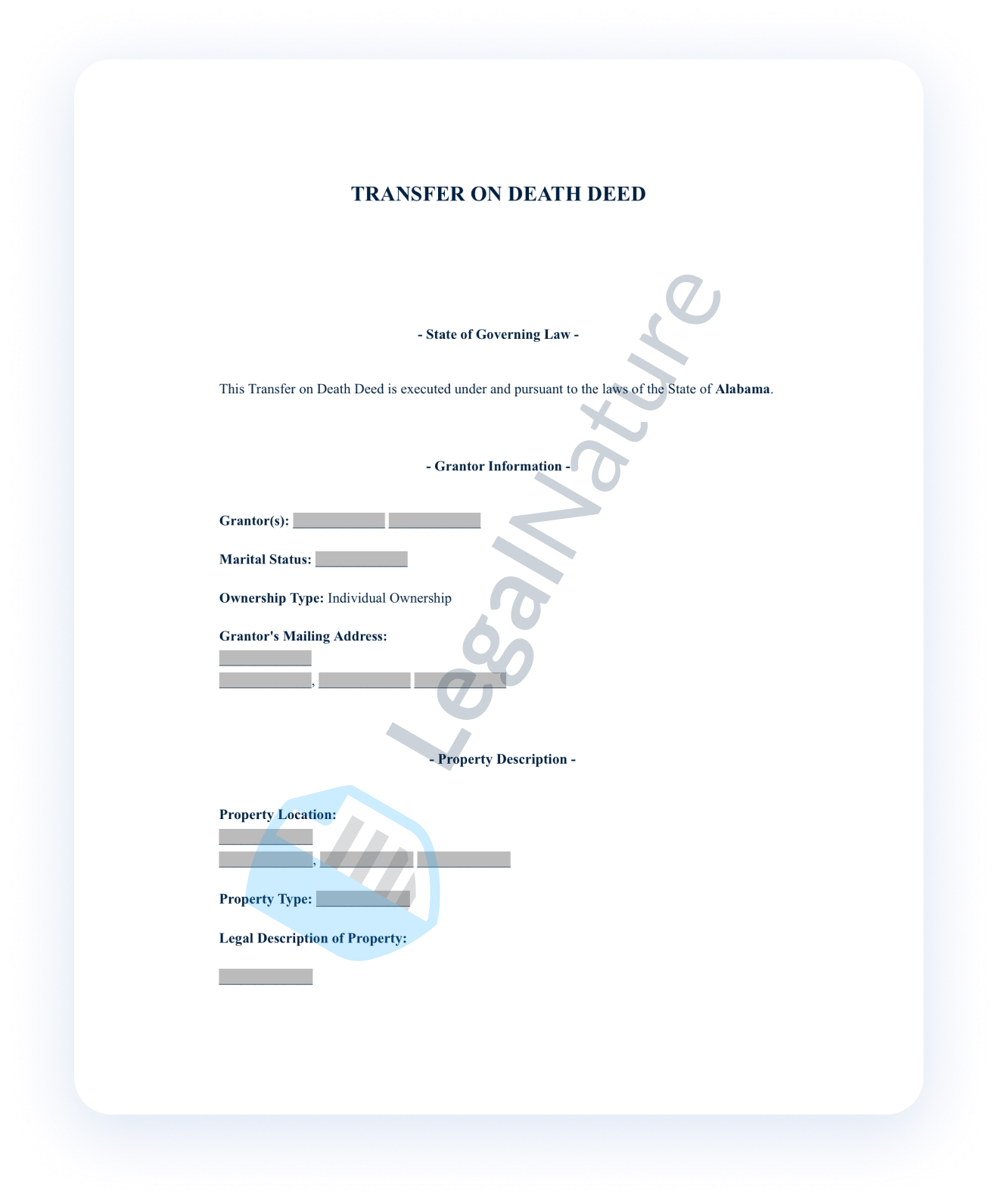
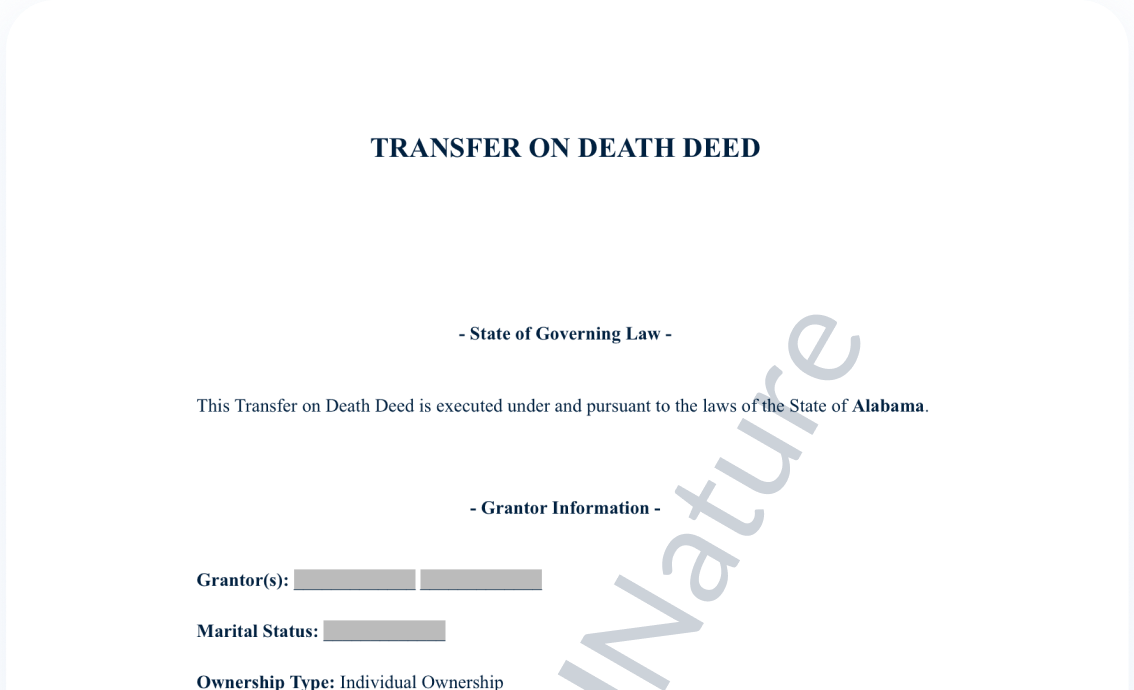
A transfer on death deed is a revocable, non-possessory legal instrument. "Revocable" means you can change or cancel it at any time before your death. "Non-possessory" means the beneficiary you name receives no rights to the property while you are alive. Understanding that distinction is essential, because it is the most common point of confusion among people creating these deeds.
There are two primary parties involved in creating a transfer on death (TOD) deed:
- Grantor - the current property owner who creates, signs, and records the deed. The grantor continues to own and control the property fully — paying taxes, maintaining insurance, and making decisions about the property — until death.
- Beneficiary - the person or entity who will receive the property at the grantor's death. The beneficiary has no ownership interest, no right of access, and no ability to sell or encumber the property while the grantor lives. Their interest only vests — becomes real — at the moment of the grantor's death.
To be valid, a transfer on death deed generally must be recorded with the county recorder, register of deeds, or county clerk in the county where the property is located before the grantor's death. An unrecorded TOD deed has no legal effect in most states regardless of when it was signed or notarized.
Unlike a will, a transfer on death deed transfers property automatically at death — no court involvement required.
Other property deeds
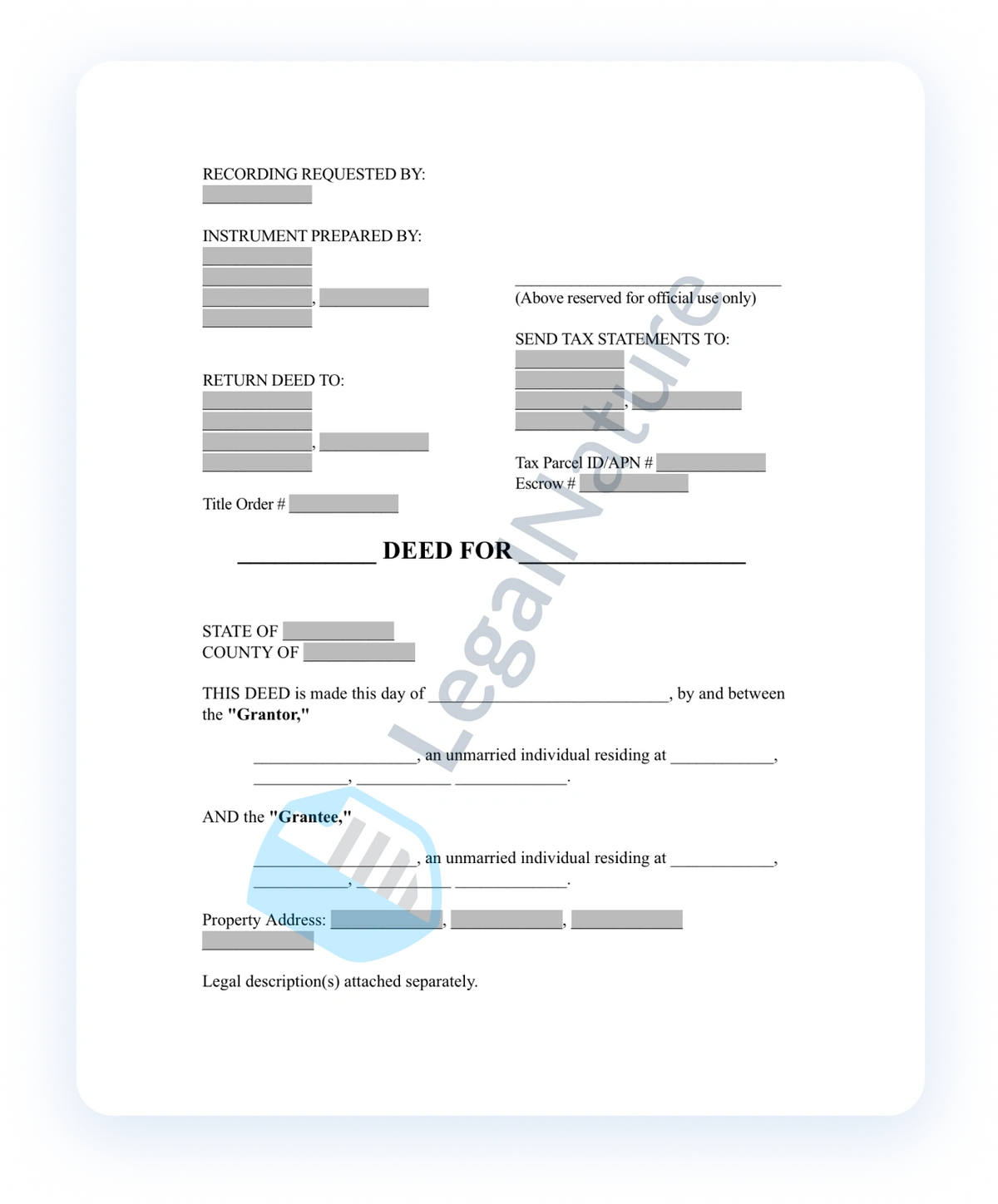
Property Deed A property deed is a legal document that transfers ownership of real estate from one party (the grantor) to another (the grantee). It serves as the official record of that transfer and must typically be signed, notarized, and filed with the county recorder's office to be legally effective.
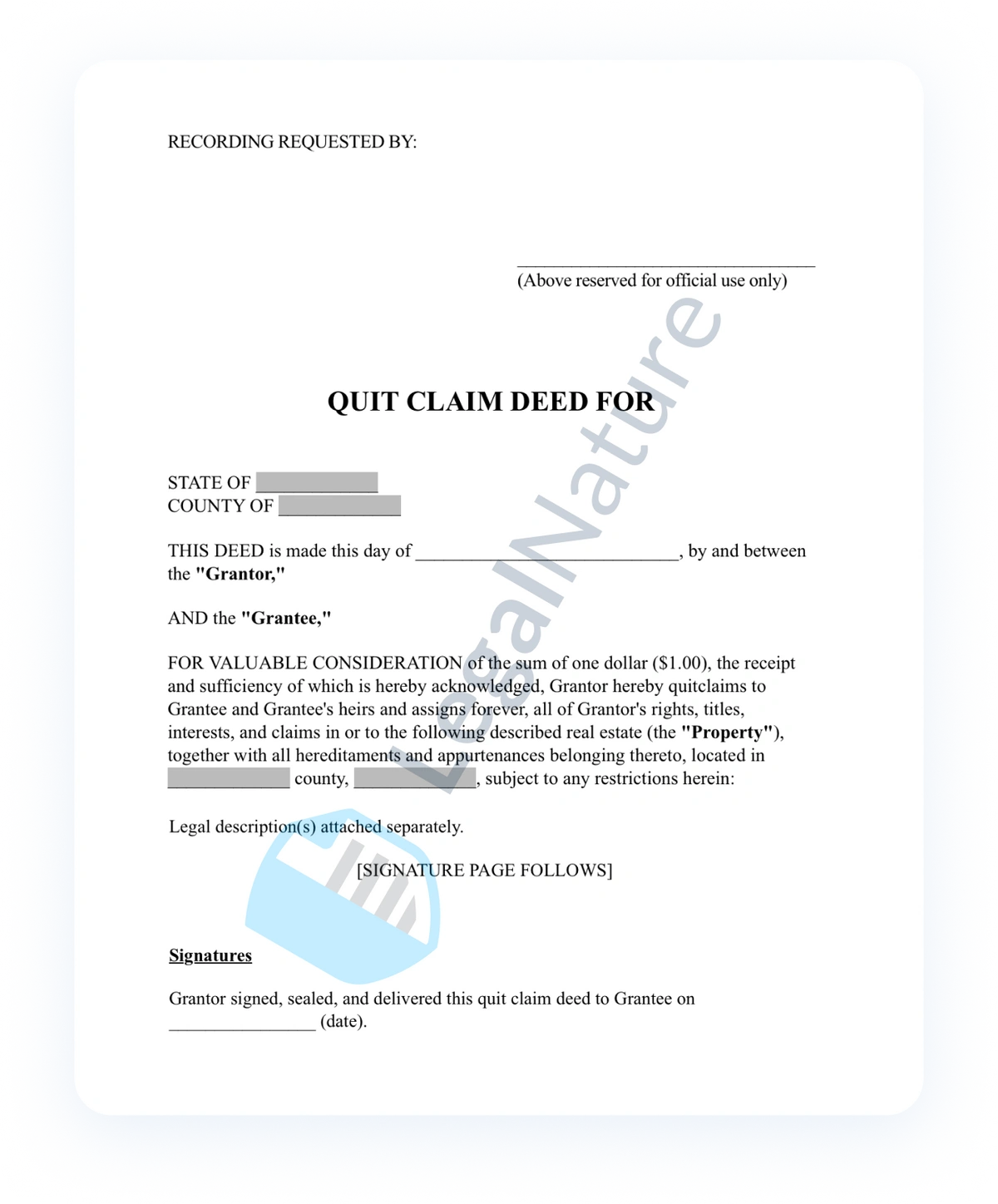
Quit Claim Deed Transfers whatever ownership interest the grantor currently holds in a property without any guarantees that the title is clear or free of liens. It's commonly used between family members, divorcing spouses, or to clear up title issues rather than in standard real estate sales.
Create a transfer on death deed in your state
Why use a transfer on death deed?
For property owners who want to pass a home or land to a specific person without the cost and delay of probate, a transfer on death deed is often the simplest tool available.
It bypasses probate
Probate is the court-supervised process of validating a will and distributing an estate. It can take months and costs money in court fees and attorney's fees. A properly recorded TOD deed transfers real estate directly to the beneficiary at the grantor's death without any court involvement. The beneficiary simply presents a death certificate and an affidavit of survivorship to the county recorder to complete the transfer.
You keep full control until you die
Adding a joint tenant to your deed changes the legal ownership of your property right now and once you do, that person has co-ownership rights you cannot unilaterally undo. A TOD deed works differently. The beneficiary has no legal interest in the property during your lifetime. You can sell it, refinance it, take out a second mortgage, or simply change your mind about who should receive it.
You can revoke it at any time
Notice to your beneficiary is typically not required. You can record a revocation or replace the deed with a new one without anyone's consent.
The beneficiary may receive a tax advantage
When property passes through a TOD deed, the beneficiary generally receives a stepped-up cost basis meaning the property's value is reset to its fair market value on the date of the grantor's death, not the original purchase price. This can significantly reduce capital gains tax if the beneficiary later sells. Consulting a tax professional is recommended to understand how this applies to your situation.
It is far less expensive than a living trust
A revocable living trust achieves the same probate-avoidance result but it requires drafting, funding, and ongoing management. For a property owner whose primary goal is passing a single piece of real estate to a specific person, a TOD deed accomplishes that goal at substantially lower cost and complexity.
It keeps the transfer private
A will that goes through probate becomes a public court record. A TOD deed, once the transfer is complete, is recorded in the public land records, but the beneficiary designation does not pass through the probate court's public docket, offering a meaningful degree of privacy.
Transfer on death deed vs. lady bird deed
A lady bird deed, formally called an Enhanced Life Estate Deed, achieves the same core result as a transfer on death deed: the property owner retains full control during their lifetime and the property passes to a named beneficiary at death without probate. The two instruments are functionally similar but structurally different, and they are not available in the same states. Lady Bird deeds are recognized in only a small number of states, currently Florida, Michigan, Texas, Vermont, and West Virginia.
How to create your transfer on death deed
Collect the Required Information
The deed must include your full legal name (exactly as it appears on your current title), the property's complete legal description (not just the street address), and the full legal name of each beneficiary. If you are naming an alternate beneficiary, include their full name as well.
Complete Our Intuitive Form Online
LegalNature's questionnaire guides you through each required field and builds a state-specific document based on your answers.
Sign and Witness Before a Notary
Transfer on death deeds require the grantor's signature to be notarized. Some states, including California, Illinois, and New York, also require witnesses to be present at signing and to sign the deed themselves. Do not sign the deed before you are in front of the notary.
Record the Deed
A signed and notarized TOD deed that is never recorded has no legal effect. Take the original signed deed to the county recorder, register of deeds, or county clerk in the county where the property is located.

Why Use LegalNature?
LegalNature offers guidance to navigate the nuances of property transfer across all 50 states and the District of Columbia. LegalNature offers a 30-day money-back guarantee. If you're not happy, then we're not happy. Give us a call and let us help.
Frequently asked questions
Does a transfer on death deed avoid probate?
Yes. A properly signed, notarized, and recorded transfer on death deed transfers real estate to the named beneficiary at the grantor's death without probate court involvement. The beneficiary typically does not need to open an estate or obtain a court order as to the deeded property. In most states, the beneficiary presents a certified death certificate and an affidavit of survivorship to the county recorder to complete the transfer and re-title the property in their name.
Can a transfer on death deed be contested?
Yes, but on narrower grounds than a will. A TOD deed can be challenged for fraud, undue influence, lack of mental capacity at the time of signing, or improper execution; for example, failure to notarize or, in states that require it, failure to have witnesses present. Because a TOD deed transfers property outside of probate, it does not go through the court-supervised review that a will does, which can make challenges more difficult.
How do I revoke a transfer on death deed?
There are three ways to revoke a recorded TOD deed. First, you can complete and record a formal deed revocation document. Second, you can create and record a new TOD deed that names different beneficiaries — the later-recorded deed supersedes the earlier one. Third, you can transfer or convey the property to a new owner or into a trust before your death; if the deed or other transfer document is recorded, the TOD deed has no effect on that property at death.
What is the difference between a transfer on death deed and a beneficiary deed?
There is no functional difference — they are the same legal instrument with different names in different states. States such as Arizona and Colorado call it a beneficiary deed. Other states, including California and Ohio, call it a transfer on death deed or a revocable transfer on death deed. Some states use the term "deed upon death."
Can a transfer on death deed be used if there are two owners on the property?
Yes, but each owner must execute a separate TOD deed to cover their ownership share. A TOD deed only transfers the grantor's interest — it cannot convey a co-owner's share without that co-owner's participation.
Create your transfer on death deed
Complete our online form
;fill-opacity:1;'/%3e%3cpath%20fill-rule='evenodd'%20clip-rule='evenodd'%20d='M7.17816%205.46484C8.48591%205.46484%209.81742%206.23165%2011.1727%207.76529C10.8517%208.08628%2010.6467%208.28838%2010.5575%208.3716C10.4683%208.45482%2010.2514%208.6391%209.90659%208.92442C9.56182%209.20975%209.28244%209.40591%209.06844%209.51291C8.85445%209.6199%208.5721%209.73285%208.22138%209.85173C7.87067%209.97062%207.52293%2010.0301%207.17816%2010.0301C6.75017%2010.0301%206.35785%209.97656%206.00119%209.86957C5.64453%209.76257%205.28788%209.5783%204.93122%209.31675C4.57456%209.0552%204.29518%208.83229%204.09307%208.64801C3.89096%208.46374%203.58781%208.16355%203.18359%207.74745C3.95636%206.97469%204.64291%206.40107%205.24329%206.02658C5.84367%205.65209%206.48862%205.46484%207.17816%205.46484ZM7.17816%209.37024C7.61804%209.37024%207.9955%209.20975%208.31055%208.88876C8.6256%208.56776%208.78312%208.18733%208.78312%207.74745C8.78312%207.30757%208.6256%206.92714%208.31055%206.60615C7.9955%206.28516%207.61804%206.12466%207.17816%206.12466C6.73828%206.12466%206.36082%206.28516%206.04577%206.60615C5.73072%206.92714%205.5732%207.30757%205.5732%207.74745C5.5732%208.18733%205.73072%208.56776%206.04577%208.88876C6.36082%209.20975%206.73828%209.37024%207.17816%209.37024ZM7.17816%207.1768C7.17816%207.34324%207.23166%207.47996%207.33865%207.58696C7.44565%207.69395%207.58237%207.74745%207.74881%207.74745C7.8677%207.74745%207.98658%207.70584%208.10547%207.62262V7.74745C8.10547%208.009%208.01631%208.23191%207.83798%208.41619C7.65965%208.60046%207.43971%208.6926%207.17816%208.6926C6.91661%208.6926%206.69667%208.60046%206.51834%208.41619C6.34001%208.23191%206.25085%208.009%206.25085%207.74745C6.25085%207.4859%206.34001%207.26299%206.51834%207.07872C6.69667%206.89444%206.91661%206.80231%207.17816%206.80231H7.32082C7.22571%206.9212%207.17816%207.04603%207.17816%207.1768Z'%20fill='white'%20style='fill:white;fill-opacity:1;'/%3e%3c/svg%3e)
Download and print the completed deed
;fill-opacity:1;'/%3e%3cg%20clip-path='url(%23clip0_10486_8655)'%3e%3cpath%20d='M10.8931%205.49519C10.8004%205.45343%2010.6879%205.48908%2010.6427%205.57565L10.4595%205.92398L10.3128%205.85879L10.5058%205.49212L10.5069%205.48906C10.508%205.48703%2010.5091%205.48397%2010.5103%205.48194C10.54%205.4137%2010.5743%205.33324%2010.5864%205.24258C10.6239%204.97267%2010.5125%204.68749%2010.2874%204.47869C10.0733%204.28007%209.74562%204.16804%209.43445%204.18534C9.36934%204.18942%209.29984%204.20062%209.22812%204.21998C9.11446%204.25053%209.00302%204.30349%208.8982%204.37785C8.82316%204.4308%208.71833%204.52146%208.64661%204.64877L8.64551%204.65184L8.64441%204.65387L7.9603%205.95657C7.95698%205.96166%207.95369%205.96675%207.95037%205.97286C7.94705%205.97795%207.94485%205.98406%207.94265%205.99017L6.17057%209.36151C6.14408%209.41244%206.13085%209.46947%206.13305%209.5265V9.52752L6.17277%2010.6143C6.17718%2010.7202%206.22022%2010.819%206.29194%2010.8964L6.18712%2011.0919C6.14078%2011.1775%206.1794%2011.2814%206.27207%2011.3242C6.29856%2011.3364%206.32724%2011.3425%206.35483%2011.3425C6.42435%2011.3425%206.49056%2011.3069%206.52366%2011.2458L6.62516%2011.0553C6.64061%2011.0563%206.65495%2011.0573%206.6704%2011.0573C6.77412%2011.0573%206.87673%2011.0278%206.9628%2010.9687L7.91392%2010.325C7.93379%2010.3118%207.95254%2010.2955%207.96909%2010.2792C7.97241%2010.2761%207.97461%2010.2731%207.97793%2010.27C7.9989%2010.2476%208.01655%2010.2222%208.0309%2010.1957L10.1483%206.16942L10.2951%206.23461L9.35169%208.02823C9.30645%208.11379%209.34507%208.21768%209.43886%208.25943C9.46535%208.27165%209.49293%208.27674%209.52052%208.27674C9.59004%208.27674%209.65735%208.24109%209.68935%208.17896L10.7023%206.25293C10.7078%206.24581%2010.7133%206.23766%2010.7177%206.2295C10.7222%206.22134%2010.7244%206.21422%2010.7277%206.20606L10.9804%205.72533C11.0255%205.64082%2010.9858%205.53694%2010.8931%205.49519ZM6.73994%2010.6907C6.70574%2010.7131%206.6627%2010.7182%206.62408%2010.7049C6.61857%2010.7019%206.61305%2010.6988%206.60643%2010.6958C6.60312%2010.6948%206.60092%2010.6937%206.5976%2010.6927C6.5656%2010.6723%206.54575%2010.6398%206.54463%2010.6041L6.51814%209.89623C6.76641%2010.0745%207.05219%2010.2028%207.35673%2010.2741L6.73994%2010.6907Z'%20fill='white'%20style='fill:white;fill-opacity:1;'/%3e%3cpath%20d='M5.59896%2011.03C5.55151%2011.029%205.49634%2011.03%205.43897%2011.03C5.13885%2011.0331%204.57941%2011.0382%204.40067%2010.8538C4.36976%2010.8222%204.33005%2010.7652%204.3444%2010.647C4.38634%2010.314%204.58935%209.96362%204.76811%209.65499L4.79789%209.60305C4.85638%209.50221%204.91707%209.40036%204.97664%209.30056C5.14766%209.01537%205.32421%208.72%205.46433%208.40935C5.56806%208.18018%205.62542%207.96426%205.63536%207.7697C5.64859%207.50897%205.57799%207.28183%205.42571%207.09441C5.24365%206.86932%204.97774%206.70431%204.61361%206.58821C4.31128%206.49145%203.97806%206.44154%203.68455%206.39672C3.55215%206.37635%203.42635%206.35801%203.3105%206.33561C3.20899%206.31626%203.10969%206.37737%203.08982%206.47108C3.06885%206.56478%203.13505%206.65645%203.23658%206.67479C3.36015%206.69822%203.48926%206.71756%203.62497%206.73793C4.18219%206.82248%204.81444%206.91719%205.1256%207.30118C5.30986%207.52832%205.30766%207.85628%205.11788%208.2759C4.98547%208.56925%204.81444%208.85545%204.64783%209.13248C4.58825%209.23231%204.52646%209.33619%204.46687%209.43905L4.43709%209.48998C4.2418%209.82609%204.02111%2010.207%203.97146%2010.6053C3.9472%2010.7957%203.99795%2010.9567%204.12152%2011.084C4.38082%2011.3498%204.8939%2011.3763%205.29223%2011.3763C5.34408%2011.3763%205.39485%2011.3763%205.44229%2011.3753C5.49855%2011.3753%205.55043%2011.3743%205.59456%2011.3753C5.59566%2011.3753%205.59566%2011.3753%205.59676%2011.3753C5.69939%2011.3753%205.78324%2011.2989%205.78434%2011.2041C5.78544%2011.1105%205.70266%2011.031%205.59896%2011.03Z'%20fill='white'%20style='fill:white;fill-opacity:1;'/%3e%3c/g%3e%3cdefs%3e%3cclipPath%20id='clip0_10486_8655'%3e%3crect%20width='7.91304'%20height='7.30435'%20fill='white'%20style='fill:white;fill-opacity:1;'%20transform='translate(3.08594%204.12891)'/%3e%3c/clipPath%3e%3c/defs%3e%3c/svg%3e)
Sign, notarize, and record your deed
